Sunday, June 2, 2019

Ascension: Why Aren't We "Engaged"?


The parish council met yesterday, and on the agenda were the results of the ME 25 engagement survey that I already talked about and printed in the bulletin.

In case you've forgotten, that survey of member engagement, professionally done by the Gallup organization, measures how you feel about your parish.

At first glance, we were shocked by the key results: Twenty-eight percent of our parishioners are engaged, 51% are disengaged, while 21% are actively disengaged. This is after several years of very serious efforts to promote intentional discipleship and a culture of mission at Christ the Redeemer.

But just as I was polishing my resume to see if I could get a job teaching canon law somewhere, our friends at Gallup came to my rescue.  Our scary numbers are within a percentage point or two of the other parishes surveyed.

And then a fellow Vancouver pastor, one I quite admire, shared his ME 25 results with me. Again, they were almost the same as ours.

The parish council could only reach two possible conclusions. 

One, that America's most famous polling organizations was just giving everyone the same numbers, without bothering to tabulate the surveys.

Or, two, that almost every Catholic parish is in the same boat, battling some factors that even our best efforts can't control.

Which do you think is true?

Obviously, the second conclusion. Best practices, great music, excellent preaching, warm welcomes, interesting programs, dynamic youth ministry—they all only go so far.

Let's be clear: we're not going to give up trying. We're not going to settle for anything but the best possible parish. However... the readings for today's great feast of the Ascension answer a question that no survey ever can.

And the question is: why aren't we experiencing what Jesus promised and what Paul preached?

Forget a wussy word like engagement. Why aren't we on fire?

Because I can tell you with 100% accuracy that the two-thirds of our parish family who are not "engaged" are not burning with the hope to which God has called us. They're not experiencing anything like "the riches of his glorious inheritance."

And they—and I can say we, since I also fall short here—are not living as people clothed with power from on high.

Have we received the spirit of wisdom and revelation that St. Paul talks about in the second reading? Have we come to know Jesus and "the immeasurable greatness of his power for us who believe"?

If these words from Jesus and from Paul strike our ears as over the top, out of reach, or just plain silly, then we're certainly not engaged. Full stop.

But this is not a bad news homily. The survey asked 25 questions. God only asks you one. Do you want what the Father is offering?

If your answer is 'yes,' you only have to ask.

Although the Ascension is an important part of the Paschal Mystery, it is something of an overture to Pentecost. The Ascension is the moment when Jesus tells his disciples—then and now—that he's really not leaving them when he returns to the Father.

He is sending down the Holy Spirit, so powerfully that he calls it a second baptism.

Exactly what "baptism with the Holy Spirit" means is complex, because there's clearly some overlap with what those involved in the Catholic charismatic renewal often call "baptism in the Holy Spirit." There's no time to tackle the subject now, but Ralph Martin has a fine scholarly article on the subject.

Dr. Martin—whom many of you will remember from his visit with us last year—also offers much simpler thoughts about today's first reading.

He says "Despite having three years of the best teaching that anybody could ever have, besides having personal attention and personal spiritual direction, personal formation from Jesus ... and despite having seen the Risen Lord—Jesus said ‘you are not ready yet’. There is something else that has to happen."

"Something else has to happen to make it all come together. So wait until that happens, and what you need is to receive the promise of the Father." Having three years of instruction wasn’t enough, seeing the miracles wasn’t enough, seeing the risen Lord and being taught by him for forty days wasn’t enough.

And being baptized wasn't enough, since we can be sure the Apostles had been baptized. They had to wait for Pentecost, for the promise of the Father to be fulfilled.

One thing is completely sure: parish programs, faith studies, Alpha courses are all great. But they aren't enough. Every one of us needs to pray to be baptized with the Holy Spirit and with fire, the words St. John the Baptist uses in all four Gospels.

You don't need to wade into charismatic waters to ask Jesus to fulfill the promise we heard in the first reading today. It's a promise from the Risen Lord, who makes John's words his own: "this is what you have heard from me."

We too must wait for "the promise of the Father." And what a great time to wait—because "not many days from now" is Pentecost.

We all know that Jesus said "ask and you shall receive." How can we fail to ask for exactly what we're promised?

And if we ask—how can we fail to receive? It's unthinkable that the promise of the Father would not be fulfilled.

So let me end with an answer to the question I asked earlier in the homily: why aren't we experiencing what Jesus promised and what Paul preached?

Because we don’t ask.

Tuesday, May 28, 2019

The Promise of Peace (Easter 6.C)


I wonder how many parishioners remember the Sunday morning some years ago when we had five visiting bishops with us for Sunday Mass? 

I’ll never forget it, since they were invited to a special lunch in the rectory, and the caterer never showed up with the food!

And I certainly remember the homily given by Bishop Douglas Crosby of Hamilton, because he told a story about an Oblate priest who was a very dear friend of his and of mine.


The friend, the late Father Brendan Megannety, got a call from the hospital telling him his father was failing rapidly. So he rushed to his hometown of Welland, and arrived while his father was still conscious.
As he leaned over the bed, his father said something indistinct.

Desperate to hear his father’s last words, he leaned closer and said “Tell me again, Dad.”

Again, he couldn’t make it out.  Urgently, he pressed his father. “Try again, Dad, please try again.”

And finally, he understood what the dying man was saying. “Get a haircut.”

The story is funny precisely because we expect someone’s parting words to be profound. They are, after all, the last chance we have to advise, or comfort, or strengthen the ones we love.

Jesus spoke a whole lot of “last words.”  What scholars call his “farewell discourse” takes up almost four whole chapters of the Gospel of John. In his long address, Jesus strengthens his disciples for what lies ahead, giving them practical help in facing the trials and challenges they soon will face.


But Jesus did not give these final instructions and promises only to those who walked with him on earth.  Every direction and every assurance was meant for you and for me, meant to help us cope with the sorrows and struggles of life.

This morning we only read six verses of this lengthy “last will and testament”, but they contain the heart of our Lord’s farewell message. There are three promises that hold the key to a happy life, and the key to the Christian life.

The first promise is that the Father will not only love those who love Jesus; he will live in them. In the fancier language of scripture scholars, “A new relationship of communion and indwelling will be created between the risen Jesus and his disciples” [Martin and Wright, The Gospel of John, 249].  It’s a personal relationship that’s so intimate that Jesus says he and the Father will make their home with and in each faithful disciple.

The second promise was partly contained in the first: the gift of the Spirit. Obviously, the Spirit will dwell in the hearts of believers, for where Jesus and the Father make a home the Spirit does also. The second promise adds another dimension: the Spirit as both Advocate and Teacher. Jesus makes a total of five promises about the Holy Spirit in the farewell discourse, but this verse sums them up. He will send the Holy Spirit to continue his mission, and the Spirit will be our advocate—the one who pleads our case, who helps us out.

These promises are glorious, more wonderful than we can really understand. Which is a bit of a problem. We don’t get up in the morning and think “what I really need today is a new relationship of communion and indwelling with Jesus.”  We may not even be in the habit of turning to the Holy Spirit for support in everyday problems.

So that’s where promise number three comes in. In his third promise, Jesus offer something just about everyone wants and absolutely everyone needs: peace.

Whether it’s the single parent of screaming kids, a cancer patient, an unemployed breadwinner, a stressed-out student, or someone mourning the loss of a loved one—or even just ordinary folks coping with the insane pace of modern life, we all want peace.

That’s obvious enough, but in today’s Gospel Jesus tells us that he wants us to have peace, too. It’s not just because he wants us to be happy, but because peace is really necessary if we’re to know and serve God.

In his little jewel of a book, Searching for and Maintaining Peace, Father Jacques Philippe sums this up: “God is a God of peace. He does not speak and does not operate except in peace, not in trouble and agitation.”

What Jesus promises is something fundamental to our relationship with him. And he goes out of his way to steer us clear from the wrong idea about peace when he says that the peace he gives is not what the world calls peace.

Father Jacques writes that we’ll never know peace, or know it only very briefly, if we understand it as the absence of problems, annoyances and worries. That’s peace as the world gives. God’s peace is something else—it’s a gift from God, not a set of circumstances when everything’s going right.

In fact, we need God’s peace most when everything’s going wrong.
One of the reasons I love Searching for and Maintaining Peace so much is that Father Jacques very accurately lists the reasons we lose our peace: the troubles of life, the fear of being without something, the fear of suffering, the suffering of those around us, the faults and shortcomings of others, our faults and imperfections, decisions we have to make, and—last but not least—our sins.

This guy knows human nature, that’s for sure. But he says every one of these reasons for losing our peace is a bad reason. Every single one.
I think we can all agree, then, that God’s peace is worth having. Really worth having. So how and where do we find it?

Today’s Gospel passage has one answer at the beginning and one at the end. At the beginning, Jesus says “Whoever loves me will keep my word, and my Father will love him…” In short, “love and obedience go together.” [248] To receive what Jesus promised his disciples, we need to be disciples:  we must live what he has taught.

At the end of today’s Gospel, Jesus invites the disciples to rejoice, even when they think they’ve lost him—because they won’t really lose him at all. Only when Jesus finishes doing what the Father sent him to do will the Spirit come. We too must rejoice at this perfect plan, whereby Jesus is with us all the time, living in our hearts with the Father and the Holy Spirit.

As Pentecost nears, we need to expect new life in the Spirit. We need t pray for new life in the Spirit. Because it is the Spirit who brings peace.

And Jesus tells the disciples to keep believing—even when things turn very dark on Calvary. We also must believe. Faith is a foundation for peace. Only by faith can we believe that God is greater than the evils around us, and so preserve our peace; only by faith can we believe that God will use our misfortunes for our good, and so maintain our peace.

In short, faith is the pathway to peace.

And peace is probably what filled the heart of my friend’s father when he had no greater worry on his deathbed than the shaggy hair of his son, the priest...

Sunday, May 12, 2019

Many Things on Mother's Day!

My aunt Denise spent a couple years as a religious Sister before she married and raised six kids. One day I was sitting with her in the kitchen as the sounds of fighting children came up from the basement.

She grinned at me and sighed, "I should have stayed in the convent."

Of course she was only kidding. But just in time for Mother's Day, I stumbled across a new book about women who do wish they'd never had kids.  It's called Regretting Motherhood: A Study, and it interviews with women who see no advantages in motherhood, or who judge that the negatives outweigh the positives.

It's a funny book to talk about on Mother's Day, but it helped me think not only about mothers but about fathers and even God himself.

It brought to mind two points.

The first is that that love can be a choice. None of us is lovable all the time--and yet our parents keep loving us, at least most of the time. Even the women in the book Regretting Motherhood seem to keep loving their children, despite their quiet regret.

The women in the book are a small minority for whom I feel sad, but they are heroes in their own way--I only read a short summary of their interviews, but it seems they care for their children much like other mothers. Making up your mind to love when you don't feel like loving is a tremendous thing.

And the second point is that love can be messy sometimes. Mothers aren't perfect. Children aren't perfect. Feelings, too, can be flawed and confusing.

Oddly enough, these thoughts turned my mind to today's Gospel. The Good Shepherd loves his sheep because they're his. He protects them because the Father entrusted the flock to him. What belongs to the Father belongs to the Son.

A sheep who strays doesn't forfeit God's love any more than a child forfeits a mother's love. God speaks through the prophet Isaiah, who writes "Can a woman forget her nursing child, or show no compassion for the child of her womb? Even these may forget, yet I will not forget you."

God's love for us is a perfect love. But in the messy realities of a sinful world, he expresses it through imperfect people, particularly our priests, whom we think about on Good Shepherd Sunday. They are ordained to tend his flock, but sometimes they nod off, and in the worst cases even join the wolves.
Yet the deeper reality is there despite the confusion and sin of life, despite priestly and parental failures. The second reading reminds us that the Lamb of God is the real shepherd of the flock, the unfailing guide to springs of water and of life.

Somehow God is there amidst the sorrows and pains all of us experience some of the time, standing by to wipe away every tear, like a caring mother does for her child.

We face a challenge as members of Christ's flock and as members of human families. We need to live with our own human imperfection and with all human imperfection--without losing touch with the love that is all around us, sometimes unseen. As the Letter to the Hebrews says, we need to keep our eyes fixed on Jesus.

Because if our parish, the archdiocese and the universal Church aren't about Jesus, they're not about anything worth supporting, especially at a time of so much public failure and scandal.

This Sunday we kick off our annual Project Advance campaign.  This year's parish theme, "Open Wide the Doors to Christ," is connected to some of the things I've just said. 

In the first place, the theme reminds us of our desire to open the doors of welcome to all. The campaign will support Alpha and other ways we invite people to walk in and feel at home here.

In particular, we want young people to feel at home in the parish, so one of our major projects is refurnishing and refurbishing the youth room and adding modern audiovisual equipment.

In the second place, this year's Project Advance will open the door of generosity to a flock that's larger than our parish or even our Catholic community. We will make a grant to Harvest Project, the North Vancouver charity that offers "a hand up rather than a handout." We will give an equal amount to L'Arche Vancouver, in memory of L'Arche's founder Jean Vanier, who died this week.

And to express our commitment to the protection of the unborn and vulnerable, we will be making a donation to National Campus Life Network, which helps educate university students to deal with the so-called "pro-choice" arguments that dominate their campuses.

Finally, our theme of "Open Wide the Doors to Christ" was chosen to connect with our most visible project for this year: replacing the aging outside doors of the church, and adding window panes to all interior doors.

The new front doors are a necessity, since they are weathered and worn out. But completing the job of adding windows on all inside doors is both practical and symbolic of the need for a new spirit of transparency in the whole Church.

We'll talk more in the coming weeks about all the good your contribution to Project Advance does throughout the Archdiocese, but charity begins at home so I wanted to start with our own projects. There's lots more information about this in the bulletin and on the website.

Speaking of the bulletin, it has an insert with the annual financial report for the parish. We can't expect your support for Project Advance without showing you how money is spent at Christ the Redeemer, not to mention demonstrating our financial needs.

If you look at the report, you'll see that we are more than $700,000 in the hole! But don't be thrown by that for a second. Almost every penny of that was our contribution to the reconstruction of St. Thomas Aquinas High School, and we had it already in the bank--thanks, in no small measure, to your past generosity to Project Advance.

If you have any other questions about the report, one of the finance council members or I would be more than happy to provide an answer.

I don't want to exhaust you by talking about so many things at once, but I have one final word about money. And, as always, it's not really about money--it's about an aspect of the Church's mission of which money is necessarily a part.

I'm referring to the fact that we have a second collection today for the Work of Vocations.
Today is not only Good Shepherd Sunday but also the world day of prayer for vocations. Support of the second collection, which helps educate future priests for the Archdiocese, comes second to prayer for them, but both are important. 

Rebuilding the Church will take a new generation of shepherds who will carry on Christ's work of guiding and guarding his flock. No present discouragement should overshadow our confident prayer that the Lord will give us such shepherds, formed in his own likeness.

The Church can disappoint us or weary us. Sometimes we have to choose to express our love for her. But like those disappointed mothers I mentioned at the beginning, we can make that choice, trusting that there’s something here much bigger than our feelings.

And on this Mother’s Day, let’s thank God—and our mothers—for their choice to love us.

Sunday, May 5, 2019

Alpha or Else? (Easter 3.C)


Being defensive is one of my worst faults. I find it hard to take criticism.  But I got a complaint on Wednesday that made me smile. 

“It’s creepy how much you guys promote Alpha—sort of like Scientology!”

He said it with a smile, which helped.

The fact is, I was happy to hear someone react to our constant talk about Alpha—it means the message is beginning to be heard, even if not everyone’s pleased to hear it.

And this good-natured criticism from a new parishioner reminded me that both new and old members of the congregation deserve an explanation for the emphasis our parish places on Alpha.

So today, I am going to explain why Alpha is so important. 

It won’t sound much like a homily, but in a way I’m preaching on one sentence from the first reading: “we are witnesses to these things, and so is the Holy Spirit whom God has given to those who obey him.”

First, let me give you some background to the question “why are you always talking about Alpha?”

In 2012, the Archbishop followed the example of Caesar Augustus and decreed a census. But it was a very different census from the one that brought Mary and Joseph to Bethlehem—it was a head count of all those attending Mass on two given Sundays in October. It’s been taken every year since.

That year, an average of 959 people came to Sunday Mass in our parish. Six years later, in 2018, the number was 763. That's a decrease of 20%.

Let’s look at the figures for just one year. In 2017, we had 813 at Mass; when we compare that to the 763 who attended in 2018, we see a drop of 5% in one year.

These declines may not seem drastic, since we spread out in the pews and enjoy more parking spaces.

It’s possible, perhaps, that the numbers are a just a result of housing prices and young people moving away. Maybe we’re really a thriving parish that just has to downsize and accommodate ourselves to changing demographics..

But I’m afraid there’s another set of numbers we have to deal with: the results from the ME25 survey we conducted in March. That professional survey was designed to measure member engagement—which is another term for the spiritual health of our parish.

The key result? Less than a third of our parishioners are engaged. Fully half are not engaged, and one in five is actively disengaged.

I can also give you those numbers as percentages. Twenty-eight percent of the members of our parish are engaged, 51% are disengaged, while 21% are actively disengaged.

Now don't panic—disappointing as those figures are, they’re fairly typical for both Catholic parishes and other churches overall. 

But think what it means: fewer than one in three members of Christ the Redeemer can be described as strongly connected, spiritually committed and—here’s where Alpha comes in—likely to invite friends, family members, and coworkers to parish events. Because that’s what “engaged” means.
  
The survey got very specific on this last point. People were asked to respond to the statement “In the last month, I have invited someone to participate in my parish.” Forty-six percent strongly disagreed. Nine percent strongly agreed. And these results are not typical of other parishes, where the figures were significantly more encouraging.

I hope it’s becoming clear why Alpha looms so large in the parish plan. First, because we need to do something. But also because Alpha works.*

Father James Mallon, who wrote the book Divine Renovation, puts it this way: there may be a better tool than Alpha, but I haven’t found it yet. (cf. Divine Renovation, 142)

Until something better comes along, Alpha’s our best hope and the simplest way we can do something to change our parish and change our world by sharing the Good News with those who haven’t heard it.

We invite family and friends to Alpha because we are witnesses to the death and resurrection of Jesus, like Peter and the Apostles in the first reading. That’s what the Alpha film series is all about: the core message of Christianity.

Bringing people to Alpha is a concrete and practical way to obey the final commandment Jesus gave to his Church and every one of the baptized: “Make disciples of all nations...” (Mt. 28:19)

Last and least, the only way to reverse the decline in the membership of our parish is by inviting people to “come and see” what Jesus is doing here.

I hope I have made the “four-e” case for Alpha: it’s an effective and easy way to become engaged and to evangelize. But I do have something to say to the fellow who finds such a strong case a bit “creepy,” and to anyone else who worries that we oversell Alpha.

Although promoting something urgent has to be focused and frequent, I don’t want to give anyone the impression that it’s “Alpha or else”!

It’s not.

Of course you can share your faith in numerous ways other than Alpha. Some of our parishioners have a tremendous gift for giving personal witness to Christ, even with strangers.

Of course you can invite people to Mass, especially at Christmas. One of the women I baptized at Easter began her journey when coworkers asked her to come with them to Midnight Mass.

But one-on-one evangelization is challenging for most of us—a lot more challenging than inviting someone to an Alpha dinner or coming out to help.

And of course you can offer your daily sufferings and prayers for the work of evangelization, especially if life is demanding and you have few opportunities to invite someone to Alpha, much less volunteer.

So it’s not “Alpha or else,” even if our enthusiasm sometimes makes it sound that way. What I have tried to get across is that doing something to share your faith, whether it’s through Alpha or not, is a duty. An obligation. A Christian commitment.

Hearing that is really what can rattle people, I think. Alpha just makes our duty hard to ignore, because it offers such an easy way to fulfill it.

An American pastor once said “if our vision is not so big that it scares the living daylights out of us, it may be insulting to God.” (Divine Renovation, 282)

I may have scared the fellow who fears we are secret Scientologists. But I know we have not insulted God by embracing a vision big enough to live up to our Christian call, change our Catholic culture, and renew our parish.

Because “we are witnesses to these things, and so is the Holy Spirit whom God has given to those who obey him.”
-----------------------------------
* Since 2012, we’ve welcomed over 1200 guests. Last year’s post-Easter Alpha attracted 150, and the current Alpha has 100—more of them unfamiliar faces than in the past.

We have three whole tables of younger adults, and 38 guests identified themselves as “searching/spiritual/skeptical" versus Catholic, a clear indication that this Alpha is starting to draw in "unchurched people and non-Catholics.”

Sunday, April 21, 2019

Easter Promises Are Personal

Throughout Holy Week, many journalists connected the smoking rubble of Notre Dame to Easter. In a splendid editorial, the National Post observed “The joy the world felt at Notre Dame’s survival… is just a taste of the joy and thankfulness all Christians will know this Holy Week.”

I give these writers, especially in the Post, full credit for their efforts.

But today, fresh images of disaster replace those from Paris. Now our screens and newspapers show us something far worse than the Notre Dame fire—churches in Sri Lanka bombed just as our brothers and sisters gathered to celebrate the Resurrection of the Lord.

This targeted attack on three Catholic churches in three different cities, along with bombs in luxury hotels, has already taken more than 200 lives, with numerous more injured.

All of a sudden, a burned building in Paris seems a weak metaphor for Easter faith.

The deaths of so many Christians this Easter Sunday is far more sobering than Monday’s fire—we’re no longer talking about a church rising symbolically from the ashes, but about people rising from the dead.

The families of those killed in Sri Lanka will surely draw strength from the Resurrection of Christ. They came to church to hear that “God raised him on the third day and allowed him to appear,” as St. Peter preached in the first reading.

They were ready to profess the Creed, in which we proclaim our faith in the resurrection of our own bodies—the belief that we also will rise from our graves on the last day.

These truths are light in darkness, and surely great consolations for those who mourn. But there is more, other consequences of the first Easter morning that are connected not only to times of tragedy but to our whole outlook on life.

The title of a book by Anglican priest Fleming Rutledge captures what we’re dealing with. It’s called The Undoing of Death. A parishioner gave me the book two years ago, and it’s shaped how I look at Easter ever since.

We need such books, because we can’t just listen to this morning’s Scripture readings; we need to unpack them. We don’t just need to believe them, we need to apply them to our individual lives.

That was how Father Giovanni approached Good Friday in his very fine homily. He stressed that no matter what is troubling us, we can take it to the Cross of Christ; we don’t need to bear our crosses alone, because Jesus bore our crosses as he carried his.

While I listened, I thought “he’s talking to me about how I’ve been feeling lately.” Then I talked yesterday to a parishioner who is caring for a sick family member, even though he’s ill himself. He said “that homily spoke right to us and our crosses.” Someone else said she hoped a friend struggling with depression was listening to the homily.

The truth is that the Resurrection is every bit as personal as the Crucifixion. Jesus not only bore our sins, he shared his victory with us—not only in the general resurrection of the dead, still to come, but here and now, in our particular needs and circumstances.

Fleming Rutledge exclaims “Changed! Our sinfulness exchanged for his righteousness, our mortality for his immortality, our sorrow for his joy, our bondage for his freedom, and our deteriorating human body for an altogether transformed one…”

She asks a question that each of us must answer: “Can you imagine anything more wonderful than this?”

And she answers: “On the contrary, we can scarcely begin to imagine it, for it does not come from human imagination but from God. All our sins wiped away, all evil done to death forever, the devil and his hosts destroyed, our loved ones restored to us, all the injustices and wrongs of human history made right in a new heaven and a new earth.” [p. 247]

I confess that I can be a bit black and white about some things. But it does seem to me that you can’t dodge the question this morning. You can, of course, deny the fact of Christ’s Resurrection, although the prophets foretold it, witnesses beheld it, and both Peter and Paul proclaimed it.

We are free women and men, and if we choose not to seek the things that are above, no one can force us. But it ought to be a conscious choice. Given all that’s promised this Easter Day—righteousness, immortality, joy, freedom from bondage, and a transformed body, how can we not at least look for an answer to the question, “Can you imagine anything more wonderful than this?”

Perhaps before now you’ve never thought very much about the consequences of Easter—what Jesus rising from the dead can mean for you personally. Maybe you’re a non-Christian visiting us, or a Catholic who was never given the chance to explore what Easter really meant for you personally.

It’s a bit tough to sort it all out on Easter morning. That’s why we invite you to share Easter with us in a more relaxed setting—but with the energy and excitement that Peter and John and Mary experienced at the tomb of Jesus.

We’re inviting you to attend an Alpha evening here this Thursday, April 25. Alpha begins at 6:30 with dinner followed by a lively film that introduces the big picture of Christian life.  No pressure, no preaching.

You can pick up an invitation at the table in the foyer. It comes from a community of friends that doesn’t want to push anything on you, but to help you find the answers to your own questions, and to discover how Easter can be a 24/7, 365-day blessing for you, whatever your particular hopes, fears, or needs may be.

Alpha costs nothing and expects nothing from you. But you can expect a chance to look for answers to your questions, and to the big question of Easter:  “Can you imagine anything more wonderful than this?”

This morning, I can’t imagine anything more terrible than sitting in church as hateful terrorists kill or injure those gathered to celebrate God’s love and mercy. But, at the same time, I can’t imagine anything better than the faith that promises hope and healing in this world, and life forever in the next.

Saturday, April 20, 2019

Easter Vigil: A Tour of Unseen Realities


Eight weeks ago today, I marveled, not for the first time, at the magnificence of the cathedral church of Notre Dame in Paris. I gazed at the glorious rose windows, at the lofty gothic arches, and admired the statues.

But there was something hidden that I didn’t see, that almost no one saw until the tragic fire on Monday—the wooden beams that held up the roof. They were concealed from view, though they’re famous now for fueling the flames.

The beams were put in place eight hundred years ago, each made from a single tree, 13,000 of them. No forest in France contains such trees today.

As we know, the stone walls of the cathedral survived the destruction of the roof, and Notre Dame will rise from the ashes, rebuilt and strong.

No-one but historians and architects will really mourn the loss of all those unseen beams. But we should: they are a reminder of the invisible things that make visible things strong and durable.

Tonight, the Church gives us a tour of  the framework of our salvation. We know well the main story—the triumphant resurrection of Jesus is as central to our faith as Notre Dame to the city of Paris. 

But there are other stories that connect to Easter, and by listening to them we understand that God’s plan, however simple in its essentials, is far more glorious than the most magnificent of cathedrals.

The liturgy at this great Easter Vigil could easily begin where we left off on Good Friday.  Jesus has died, now let us hear the Gospel of his Resurrection. Yet the Church makes us wait for the whole story, and invites us to wonder as we wait.

Paying no attention to our impatience, the readings began at the dawn of creation—with the goodness of creation, the first expression of God’s love for us.

We responded in song, praising God for his works and wonders. But the psalm’s antiphon, “Send forth your Spirit, O Lord, and renew the face of the earth” expresses the fact that what God created needs renewal: a new creation is called for.

The second reading presents the source of the new creation: it will be a sacrifice. The sacrifice of an only son.

That’s enough to make us afraid, so in the psalm we renew our confidence in God, who will keep us safe and strong, and bring joy regardless. God kept his promises to Abraham, and he will keep his promises to us.

The third reading offers further encouragement to the hesitant and fearful.  God not only keeps his promises, he keeps them with power and might. We’re not part of a TV show called Survivor; a reality show about Christians would be called Victor.

Our fourth reading moves from history to our own hearts. Isaiah invites everyone here tonight to take stock. Are we thirsty and hungry? The prophet knows that only the foolish are fully satisfied with life; he promises on God’s behalf what the heart most longs for—a relationship that fulfills our deepest desires and answers our most troubling questions.

We use Isaiah's own words in response—we “will draw water joyfully from the spring of salvation.”  Lowering our buckets into the well of salvation is the source of the greatest joy imaginable. Tomorrow I will invite our many Easter visitors to experience that joy, by putting Alpha on their bucket list—not for the future, but for this coming Thursday.

I will promise them the joy that comes from knowing Jesus if they will take the simple step of seeking the Lord while he may be found, in an evening of welcome, fellowship, and hope in God.

I don’t need to talk much about that tonight, because three of our five catechumens and confirmation candidates, attended Alpha, heard an invitation from Jesus, and came to know him better through the Rites of Christian Initiation for Adults, or RCIA. These three—and many others—can tell you about the joy of drinking living water from the well of salvation.

Not all of us have quenched our thirst with Christ, but our final Old Testament reading brings everyone God’s promise of water that washes us clean. The cleansing water of baptism brings a new heart, a heart that beats with love for God and neighbour. Ezekiel speaks God’s promise of a new spirit that helps us live a new life according to God’s commands.

The psalm that follows is not triumphant like Miriam’s song after the crossing of the Red Sea; it’s not the loud shout of joy we sang in response to the promise of thirst-quenching and hunger-satisfying blessings.


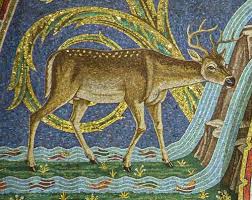
No, our last response to this forest of Old Testament scriptures is that of a panting deer, at the edge of the babbling brook that will bring relief from exhaustion. 

Dear catechumens, you are almost there! You have a right to be a bit weary, a bit impatient. But very soon you “will go to the altar of God”; very soon you will be baptized and confirmed and receive the Eucharist for the first time.

I dare not hold you back any longer from the saving water of baptism, from the strengthening oil of confirmation, and the living bread of the Eucharist.

Let me just end by proclaiming that the sturdy oaks of the Old Testament are timbers that hold up the indestructible structure of the Resurrection of Christ, in which God’s creation is refashioned and his promises fulfilled.