Saturday, January 1, 2022

Epiphany: Offering What We Have


We live in anxious times.  Just when we thought the pandemic was cooling down, it starts to heat up. And the coronavirus isn’t the only reason for worry: we saw more natural disasters in BC last year than in a typical decade.

On top of all that, we have the opioid crisis, growing homelessness, refugees drowning, and growing political tensions at home and abroad.

It makes you feel a bit helpless, doesn’t it? What can we do in the face of so much calamity?

Today’s feast of the Epiphany contains at least one answer: do what you can. Offer what you have.

The wise men aren’t well-prepared for a newborn. Everyone’s seen the old internet joke that says if there’d been three wise women, they’d have made a casserole and brought practical gifts.

But what did the wise men do? They gave what they had.

Their example offers us a way to respond to any and every crisis: we do what we can, with what we have.

There’s even a name for this: Christian stewardship.

Christian stewardship “offers us a way to re-focus our energy and provides an opportunity to face today’s challenges.” (See the fine reflection of the International Catholic Stewardship Council here.)

Sometimes we make the mistake of thinking that stewardship is all about money; that’s a particular danger on the Epiphany when the word treasure appears in the Gospel.

Yet “a conversion of the heart is needed before a conversion of the wallet or purse can happen.”

We’ll never be Christian stewards if we don’t experience the joy of the wise men, whose hearts opened wide when they reached their destination, who knelt in wonder when they saw the child Jesus and Mary.

It was the Holy Spirit who invited them to open their treasure chests in an act of homage that will be recalled until the end of time.

And it is the Holy Spirit who will help us discover what we can do to respond to the needs we see all around us.

We offer our gifts of time, talent, and treasure not simply to those in need but to God himself. Prayerfully, with the Spirit’s guidance, we ask him “what should I do?”

Over the years, we have talked about stewardship many times in the parish. But this feast of the Lord’s Epiphany can inspire us to think about what’s most precious to us, and how we are called to share it.

Surely the most precious of all our gifts is our faith. We are in church today because we believe in the mystery of Christ’s birth, the Word made flesh.

We believe that the ancient prophecies have been fulfilled, and that the world no longer needs to fear the darkness; the light has come.

Isn’t that the first treasure of which we are all stewards? Aren’t we called to take our faith out of its box and share it with others, especially those who most need the hope it offers in these difficult times?

In less than three weeks, Alpha will begin online.

If your heart needs to hear a Gospel message of hope, please sign up. Perhaps more importantly, ask the Holy Spirit to point you to the friends, neighbours, and family members for whom Alpha could bring light and peace.

Charity, as they say, begins at home. But today’s feast also reminds us of the global picture. All nations are called to Christ’s light and all people matter to us. We see this clearly in the psalm, where the tribute offered to God is given to the needy, to the poor, to the abandoned, and to the weak.

And so it is that the parish pastoral council and the parish finance council has decided that Christ the Redeemer will again sponsor a large refugee family, this time from Eritrea in Africa.

We’ll share details in the coming weeks, but for now I can only rejoice that our parish community can make this commitment thanks to its deep spirit of stewardship and charity.

There are many needs besides Alpha at home and refugees abroad. So this Epiphany let’s ask ourselves “what else is in my treasure chest? What more can I do with the time, talent, and treasure that God has given me?”

In a tough time, we do what we can, with what we have.

Mary, Model of Prayer (January 1)


Most of the reflections in my brief homily today are not my own: they are my rough translation of the commentary on the readings offered in Le Letture Bibliche delle Domeniche: Anno C by Albert Vanhoye, SJ. Cardinal Vanhoye, who died last July, was a brilliant and pastoral scripture scholar, and wrote in a wonderfully clear Italian, perhaps because it was not his first language.

But I have one personal thought to share. Those of you who have come to Mass today are doing a very Catholic thing.

All Christians have a solemn invitation to Sunday worship; it comes from the Ten Commandments and ancient tradition. It’s a matter of divine law.

But this holy day—other than Christmas, the last remnant of the seven or so holy days of obligation we observed when I was in elementary school—is a matter of Church law. You’re doing a truly Catholic thing, obeying the authority of the Church by attending Mass.

Of course, I am not suggesting that all or even most of you are here simply because you’re supposed to be! We begin a new year today and we begin it under the protection of Mary. That too is wonderfully Catholic.

Eight days after the birth of Jesus we recall his mother: and in a special way we ask her to obtain peace for us, since today is also the world day of prayer for peace.

The first reading is chosen precisely for the first day of the year: it’s a priestly blessing taken from the Book of Numbers.  The formula of the blessing is extraordinarily rich. It invokes the sacred name of the Lord three times and prays that we will live under the watchful and gracious gaze of our loving God.

But the last word of the blessing is peace. And here we ask not only for the absence of war but rather prosperity, welfare in all things, a truly happy new year free from conflict and distress.

The Gospel leads us back to Bethlehem, to that timeless picture of Mary contemplating her newborn son. At the beginning of this new year, we ask for the grace to know her a little better, to understand her place in our lives and in our Church.

We get a glimpse of Mary’s profound interior life as she ponders Christ’s birth in her heart. Deepening our own inner life through the reading of scripture, times of reflection, and especially by meditating with the Rosary would be a terrific new year’s resolution for any of us.

The second reading tells us that we will have lots of help if we decide to imitate Mary by treasuring the mysteries of our faith through regular prayer. The Holy Spirit who first came to Mary now comes to us; yes, she is the Mother of God, but we are sons and daughters of God, and the Spirit dwells in our hearts.

What a blessing for us to begin 2022 together with Mary, together with the Church, together with one another.

Saturday, December 25, 2021

Children's Mass (Christmas 2021)


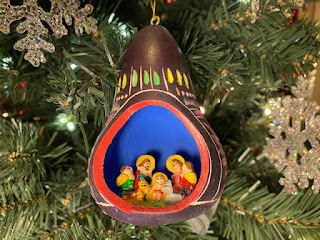
We have a wonderful family in our parish who moved to Canada from Peru. They just gave me a lovely gift – a brightly painted Christmas ornament from South America.

 It’s made from a gourd, a hard-skinned fruit that’s been hollowed out and dried. Gourd carving has been associated with Peru and other countries in South America for hundreds of years.

You can see it’s quite pretty; there’s a cheerful little bird chirping at the bottom.

It would look nice enough on a Christmas tree, if I hung it as you see it now. But if you turn it around, you see that the ornament has a heart. Far from being hollow, like most of the decorations on my tree, it has tiny figures of Jesus, Mary, Joseph, shepherds, and animals. 


We have to decide every Christmas whether to look at one side or the other – to focus on the colourful decorations or to take a careful look at what Christmas is all about.

 Sometimes it’s easier just to see Christmas from the outside. Certainly, at least with my eyesight, it takes a bit more effort to look into the heart of this celebration.

But there’s so much to learn when we take the time to gaze at the miracle we are here to celebrate tonight.

 You can be sure that the shepherds couldn’t take their eyes off the angel. And when the angel left, they were changed, they were eager, and the result was that they received the priceless gift of seeing Mary and Joseph and a child lying in a manger.

We have a beautiful crib in our parish, and I hope that many of you will visit to say a prayer. But no matter how long you look at the statues, you will not find Mary and Joseph and their child. Because they are not statues!

But if you look into your heart, you will find Jesus, Mary, and Joseph. You will be able to speak with them. You can imagine how the shepherds felt, and you can feel that way too.

All you need to do is make up your mind and change the angle from which you view Christmas. Opposite the shiny and colourful side there is the real meaning of Christmas, which is the appearance of God our Saviour with goodness, loving kindness, and mercy.

We adults can lose our sense of wonder. We’ve had many Christmases and maybe we have begun to take the annual celebration for granted.

That’s why our parish wants to offer adults, young and old, a chance to look at Christmas with fresh eyes – an opportunity to get inside Christian faith. Alpha is an eleven-week video series that helps us understand why God became man and what that means for us. 

Please join us January 20, on line!

Friday, December 24, 2021

Overpowering Every Darkness (Christmas 2021)

The star of Bethlehem does not shine in the Christmas story we heard tonight. The story of that star is told in the Gospel of Matthew, and we have just listened to the Gospel of Luke.

But we can be sure that the chorus of angels lit up the night sky, bringing light to the darkness as they heralded the birth of Christ.

The angelic host was announcing the news that the prophetic word of Isaiah—what we just heard in our first reading—had been fulfilled!

In the darkness of the night, a great light shone. A light that the darkness cannot overpower, as St. John tells us in his Gospel.

A joyful light. A glorious light.

I do not want to dim the brightness of this holy night in any way. Like you, I rejoice that a child has been born for us. And yet, I want to invite you into a difficult experience that my family and I are facing this Christmas.

A month ago, my younger brother Stephen suffered a major stroke. From the moment we got the news the doctors did not downplay how severe it was.

However, they gave us hope. And we have held on to that hope during these anxious days.

But there was something the doctors did not give us: promises. The hope they offered came without promises for the future. And this, of course, is as it should be, since recovery from stroke is a long and uncertain process. Doctors do well to be encouraging, but would be wrong to make promises.

What a contrast with God’s word spoken to us at Christmas! 

Like the doctors, the scriptures give us hope. But unlike the doctors, God makes promises. Christian hope is backed by promises. God will accomplish His plan in us, unobstructed by illness, human weakness, and even sin.

Christian hope promises light in any darkness. No matter what we face, we are promised light and peace, hope and joy. And most of all, a Saviour.

In various forms, the word promise appears more than 100 times in the Bible. As for the number of God’s promises, you can have some fun trying to find that on the internet. Some say a thousand, others many more than that. It depends on your definition. A Canadian teacher, after reading the Bible twenty-seven times, came up with the figure 8,810, most of them made by God to mankind.

The exact number is much less important than God’s faithfulness. When King Solomon dedicated the temple of Jerusalem, he praised God by saying, “not one of the promises he made through the servant Moses has failed.” (1 Kings 8:56 REB)

If King Solomon could say that almost a thousand years before the first Christmas, think about what God has promised us in his Son.

Isaiah’s prophetic words, “the people who walked in darkness have seen a great light,” were fulfilled that first Christmas night, but the Bible continues to promise us the joy, the peace, and the liberation we heard about in the first reading.

Because today we are the people who live in a land of deep darkness, a land overshadowed by fear and worry. The pandemic threatens us all, and some of us live with illness, suffering, and sorrow.

But the light is shining through all of that if we will open our eyes to see.

The New Testament brings us God’s promises no less than the Old. The Letter to the Hebrews tells us that the new covenant has even better promises than the first.

In his second letter, Saint Peter speaks of God’s “precious and very great promises” that free us from corruption and allow us to share in the divine nature (2 Peter 1:4).  Saint Paul speaks of something very precious indeed when he writes “What no eye has seen, nor ear heard, nor the human heart conceived, what God has prepared for those who love Him” (1 Corinthians 2:9).

Beautiful phrases, but let’s bring them down to earth – or up to heaven, as you prefer. The apostle John makes it clear: “this is what he has promised us, eternal life” (1 John 2:25).

The problem is that the promise of eternal life is both far off and unimaginable. It’s hard to get excited about a promise that won’t be fulfilled in your lifetime!

Which is why it’s so important at Christmas to see the whole picture. Which is why our parish invites you to Alpha, so you can not only hear what God offers but experience it, right now.

When you come to Alpha, you will meet people, on the videos and in your small group, who have walked out of darkness and into light. You will see the joy of Christian faith and community.

And as Saint Paul tells Titus in our second reading, you may come to understand how God’s gifts are not rewards for good behaviour. You can have an actual experience of the Holy Spirit, one of the central promises Jesus makes to his disciples.

Alpha can help you live life with the wonder of the shepherds living in the fields of Bethlehem and can challenge you to imitate their eagerness to figure out just what God has done.

We can put our hope in modern science and medicine. We can hope for human progress. After all, there’s nothing wrong with positive thinking. But what happens when we hit a wall? Then natural hope, sometimes called optimism, can fail us.

But supernatural hope is a virtue, not an attitude. It’s something you can hold on to in good times and in bad – and especially in bad. It does not depend on our emotions or circumstances.

As the Letter to the Hebrews says, we can hold fast to our hope without wavering, “for he who has promised is faithful” (Hebrews 10:23).

God was faithful to the Chosen People in exile and exodus; he kept his promises. He rewarded Abraham, our father in faith who, when hope seemed hopeless, God made the “father of many nations.” Now He promises us, in Christ, even more.

The beatitudes proclaimed by Jesus – blessings promised to the poor in spirit, those who mourn, those who suffer – do not exempt his disciples from trials. But through all those trials, “God keeps us in the hope ‘that does not disappoint,’” a hope that is “a sure and steadfast anchor of the soul.” (Hebrews 6:19)

How does he do this?

In part by the gift of a peace the world cannot give (John 14:27). It was not optimism that has seen us through the difficult days after my brother’s stroke but God’s gift of peace, because he keeps His promises.

In part by spiritual gifts like fortitude and perseverance, which make it possible to follow the exhortation Saint Paul gives in a verse that’s easy to remember, Romans 12:12: “Rejoice in hope, be patient in suffering, persevere in prayer.”

In part by the virtue of faith which makes it possible to trust my favourite verse from St. Paul, Romans 8:28: “We know that all things work together for good for those who love God.”

The same God whose infinite creativity conceived a plan to save the world through the birth of his only Son in poverty, in a manger, in an occupied territory, can bring light even to the deepest darkness.

This is the thirty-fifth time I have preached at Christmas Mass. It is perhaps the first time I have preached from such intense personal experience, an experience of God’s promise and power to fill this day—for me, my family, and for you—with the light that the darkness cannot overpower (cf. John 1: 5).

I want to share with you each of you this same hope-filled invitation, whether your Christmas dawns brightly or, like mine, has shadows. The discipleship path, to which our parish invites you through Alpha and other experiences of Christian community, is walked in both joy and sorrow.

It is a safe road through darkness—present, past, and future—leading ultimately to the brightest of all destinations, "the hope of eternal life" (Titus 1:2, 3:7). 

Saturday, December 18, 2021

Finding Peace This Week (Advent 4C)


Is it just me or does it seem almost impossible that Christmas is less than a week away?

And do you also share my sense of being unprepared? If you don’t, please send me an email as soon as you get home and let me in on your secret!

I saw a video this week that really captures how I’m feeling. [Unfortunately, its one we purchased only for viewing in church – even if I did know how to post it here! Suffice to say it was frantic!]

What do you think? For all the joys of Advent, I think that short video does a good job of showing the challenges we face in the home stretch before Christmas.

What's the answer to the problem?

I found a list of five tips for staying calm at Christmas: 1) simplify, 2) be realistic, 3) have fun, 4) get fresh air, 5) savor. 

It took me a couple of seconds to realize that number five said savor not saviour

Our liturgy for this fourth Sunday corrects that colossal mistake. It points us to the fact that we have a Saviour. And thats truly something to savor as we reflect on the readings today.

The Gospel asks us to think about what we actually believe about this feast that seems to have so much busyness attached to it. Look closely at Elizabeth: she’s not distracted by the excitement of the visit from her cousin Mary. She’s not heaving a sigh of relief at the arrival of someone to help out during her pregnancy.

No, Elizabeth knows what’s going on. Like her child filled with the Holy Spirit, she knows precisely what's happening and thus greets Mary with faith and hope. Nothing in this encounter is secondary; Elizabeth is focused entirely on the fulfillment of God’s ancient promises.

In the first reading, Micah has only a shadow of Elizabeth’s clear thinking; his astonishing prophecy “glimpses more of the future than the prophet could have possibly realized.”

[See Hans Urs von Balthasar, Light of the World, 263-264]

It’s wonderful to think that we are not just glimpsing God’s plan. Like Elizabeth, like Mary, we know that it is fulfilled in Christ.

Knowing that God has done for us what he promised is a great way to prepare for Christmas. Knowing that “we have been sanctified through the body of Jesus Christ once for all” makes us confident and focused like these two great women of the Bible.

But there’s more to being ready for Christmas than just understanding God’s plan. There’s more to being sanctified than knowing the saving work of Jesus Christ. We want to accept the gift of holiness; we need to live the salvation Christ has brought us.

We do that in many ways, of course. When we serve others in charity, as Mary did for her pregnant cousin, we make a place in our hearts ready to welcome Christ. Already much kindness has been shown during Advent by members of our parish to those in need.

When we take time to reflect on what we believe, perhaps by reading ahead of time the readings for Mass on Christmas, the Word of God dwells in our hearts and prepares us to celebrate the mystery of the Word made flesh.

When we call upon the Lord’s name and say, “we will never turn back from you,” as the psalm says, we recommit ourselves to the mystery we are celebrating at Christmas.

But before we can say “we will never turn back from you,” some of us need to turn back to the Lord—to restore a relationship that has been weakened or even lost in the stormy months since last Christmas.

What’s the point of running around madly buying Christmas presents if we won’t accept the one God wants to give us: the gift of his mercy, the forgiveness of our sins?

Christ-who-comes wants every one of us to come to him at this sacred moment in the year. He invites us to meet him in the Sacrament of Penance this week, to go to confession before we welcome his coming at Christmas.

Our parish and the other North Shore parishes are doing our best to make this as easy as possible for busy people. Fr. Lucio and I will be in the confessionals right after the 11 o’clock Mass tomorrow. Tuesday evening at 7 pm, Deacon Marty will lead us in an Advent penitential service, after which at least seven priests will be hearing confessions.

On Wednesday before the morning Mass, Fr. Lucio and I will again be in our confessionals.

I was going to say that there’s no earthly reason not to get to confession before Christmas. But then I realized that the only reasons are earthly—worldly falsehoods like thinking we don’t deserve God’s mercy or that we don’t need God’s mercy.

Such worldly thinking misses the whole purpose of the Word of God taking flesh—so that Christ can save us. He wants to save us, and He will, if we let Him.

The Church offers us an antidote to the pre-Christmas panic shown in the video. There are simple paths to peace this week. We can spend some time thinking and praying about the big picture, God’s plan. We can find some opportunity for an act of kindness or charity.

And we can open our hearts to the gifts of joy and peace the Saviour offers us in the Sacrament of Penance.

Sunday, December 5, 2021

Put on the Garments God Gives (Advent 2.C)


Take off the garment of your sorrow and affliction, O Jerusalem, and put on forever the beauty of the glory from God.

At Mass last night, here at Christ the Redeemer, Father Richard Conlin celebrated his first anniversary of priesthood with our parish, to which his whole family belongs.

When Father Richard was ordained a priest, pandemic restrictions meant that there were ten people in the 900 or so seats of Holy Rosary Cathedral.

I can’t imagine how I would have felt in his shoes. But I know how I felt in mine—very proud to be the only priest invited, and to have the honour of putting his priestly vestments on him during the liturgy.

He recalled the moment when I placed the stole on his shoulders and put the chasuble over his head: “I made Msgr. Greg cry.”

And then he made last nights congregation laugh by adding, “Of course, that’s not difficult.”

The back story began while he was on retreat preparing to be ordained. As he stood before God, he imagined himself as the prodigal son in the Gospel story. More than that, he saw himself dressed in the tattered rags that Rembrandt so brilliantly painted in his masterpiece “The Return of the Prodigal Son.”

When he told this to the priest directing him on the retreat, he gave him some unfamiliar scripture verses to read and pray with.

That prophetic passage, Fr. Richard told us, was fulfilled when I placed the priestly vestments on him at the ordination.

Which, of course, made me cry again.

Fast forward, if you will, to yesterday. Last night he told us the same story for a second time, since he had he preached here some months ago.

The same story—but with a twist.

An astonishing twist: the passage the future Father Conlin had been given to read on his retreat, the prophetic word he felt was fulfilled at his ordination, is the first reading we just heard.

When we fixed the date for the anniversary celebration months ago, no-one thought to look at the Sunday readings, so it’s by pure coincidence—or can we say pure providence—that things come full circle with this passage from the Book of the Prophet Baruch.

Small wonder that he told us the story again.

When Deacon Richard prayed with the text on his retreat, it was as if he’d never heard it before; when he told me the story, I didn’t recall the reading either.

But here it is, right in front of us on this second Sunday of Advent.

How did we both miss the importance of this reading, in my case for more years than Father Richard Conlin has been on this earth?

Pretty easy, I think. We read Baruch every three years, but it seems like just a prologue to today’s Gospel. All I ever noticed was that the first reading anticipates the words of John the Baptist: “every valley shall be filled, and every mountain and hill shall be made low.”

Until last night, I had missed the heart of today’s first reading; in fact, only last night did the words go straight to my heart.

Let’s look for a moment at the Gospel. We are stirred by John’s words, intrigued by how they echo Baruch’s, both pointing to the coming of the Saviour. All good. But what does this Gospel passage tell us to do?

Nothing, really. Not that every Gospel must be a plan for action. But the fact is you can listen to this one without being invited to any particular action.

Now turn back to Baruch.

Again, we’re uplifted by the Advent message of hope, the promise of God’s coming. But Baruch tells us to do something!

Because when the prophet speaks to Jerusalem, he speaks to us. The words “Take off the garment of your sorrow and affliction,” which spoke so clearly to the future priest on his retreat, are spoken to you and to me.

A little over a week ago, I put on the garment of sorrow and affliction, devastated by my brother’s stroke. Today, I am invited—even commanded—to take off that garment.

Not just to take it off, but to replace it with the beautiful garments of faith and hope—to put on “the robe of righteousness” that comes directly from God. This I am trying to do, so that I can receive the gift of peace God promises.

Are you wearing tattered garments of pain, fear, sin, or despair? The prophetic word today says, “take them off.” Take them off and put on the robes of beauty and glory.

What would it look like, what would it feel like, to toss out the garments of sorrow and affliction? In case it all seems a bit abstract, we have today a beautiful Psalm to provide an answer.

“When the Lord delivered Zion from bondage, it seemed like a dream.” God’s people were filled with laughter and gladness. Weeping under heavy burdens when they set out to labour, they come back singing. Knowing the great things God had done for them replaced sorrow with joy.

We all have burdens, and many experience bondage of one sort or another. Advent is a time to pray for the knowledge and insight that allows us to seek something better, as St. Paul says in our second reading, and to allow God himself to bring to completion the good work he began in us.

I have seen Rembrandt’s painting with my own eyes when I was in St. Petersburg, and I admire it as much as Father Richard, who used it on his ordination holy cards.

But if I could have made one suggestion to the great Dutch master, it would be this: there’s a servant doing nothing in the painting—I wish he were holding “the best robe” that the father ordered in the parable. The painting shows what garments of sorrow and affliction look like, so I wish we had a glimpse of the robe of righteousness.

Of course, it’s much easier to paint rags of despair than robes of righteousness. Just as it can be easier to wear them.

But we can start our change of clothes right now by rejecting the hopeless lies we are told—or tell ourselves—and live in the hope of joy and glory so richly promised us today and throughout this Advent season of preparation and hope.

Sunday, November 28, 2021

Looking Back and Ahead at Advent (


Talking about a pagan god is an unusual way to start a homily on the first Sunday of Advent, but at least his statue is in the Vatican Museum.

Janus was the Roman god of beginnings, gates, transitions, time, duality, doorways, passages, and endings.

He was obviously a busy guy. It’s no wonder that he’s usually shown having two faces, each looking in a different direction. Not right and left, but forwards and backwards.

As I thought about Advent this year, it struck me that looking in only one direction is not the way to prepare for Christmas. If we’re serious about this season, it must be much more than one of those billboards announcing how many shopping days left until Christmas.

Advent may have four weeks. But really it is beyond time. It is equally about what is, what has been, and what will be.

Moreover, it is just as connected to Easter as it is to Christmas.

I’ll get back to that, but let me point out something from this morning’s Gospel: if Advent is just a beautiful liturgical season preparing us for the joys of Christmas, why are we listening to Jesus tell his disciples about the end of the world?

Unless you’re a diehard pessimist, this Gospel doesn't help us get into the Christmas spirit.

But don’t worry: the next Advent Sundays offer us the more familiar prophecies and words of comfort. On this first Sunday, though, the Church is asking us to begin the journey in a circle, not a straight line.

Let me remind you of what I said at the blessing of the Easter candle just over seven months ago:

“Christ yesterday and today; the beginning and the end; the Alpha and the Omega; All time belongs to him and all the ages. To him be glory and power through every age and for ever.

Do those words no longer echo? Has time narrowed to a four-week preparation for the Birth of Christ?

No, dear friends, Advent is not a straight line. It’s a circle. 

To quote a wonderfully wise Irish priest, Oliver Treanor,* the circle “draws to its inner self all mankind, all history, the very cosmos itself.”

Try doing that with a straight line!

“Because of  this,” Father Treanor says, “Advent is not only the celebration of God’s coming to us, but also of our coming to him.”

Our Gospel this Sunday does not talk about celebrating, but it has much to teach us about Advent. Even as Jesus looks to the end of time, he looks to the present moment and warns us to live good lives right now so we can greet his coming without shame or fear.

St. Paul does much the same in our second reading by encouraging us to live lives pleasing to God, as we’ve been taught.

The Church is wise to give us these readings, because they remind us that Advent, second only to Lent, is a penitential season.

Father Treanor again uses the circle to make this point: Advent “is a time to mend the broken circles of our lives by returning, as a circle does, to our point of origin.”

And what is that “point of origin” but our oneness with God, made possible not only in the stable but on the cross and at the Resurrection?

There’s no surer way to mend the circle than going to Confession.

When it comes to Confession, I am a bit like a man who loves sushi and can’t figure out why everyone doesn’t. I love the sacrament of penance—I truly welcome going to confession, even though I wish I felt the need a little less often.

And I love hearing confessions. But I am hearing fewer and fewer, and don’t know why. Maybe people working from home have less opportunity to sin, but with the kids making noise during Zoom calls I would have thought it would be the other way around.

It don't think it's fear of the pandemic. We wear masks in the confessionals, and installed new higher-volume exhaust fans.

Maybe we’re all just tired.

Several parishioners have suggested that it might help if we tried making it easier for you to get to confession. So, during Advent one or both priests will head to the confessional directly after the 11 am Mass and see what happens.

Let’s think of that busy god Janus as we begin our Advent preparationlooking back not only at our sins but at the saving death and Resurrection of Christ, and looking forward not only to Christmas Day but to the Last Day when God fulfills all his promises.

-------------

* Father Treanor's book is titled Seven Bells to Bethlehem, and it is an inspiring study of the marvelous O Antiphons from the Liturgy of the Hours, also used as the Gospel acclamation at weekday Masses leading up to Christmas. It is one of the finest liturgical/theological/devotional books I have ever owned, and copies are now available on Amazon. Highly recommended!