Friday, July 15, 2022

Jason Costa 1991 - 2022


 Son – Grandson – Nephew – Cousin – Friend – Coach – Wheelchair athlete – Colleague – Catechist – Coordinator.

Jason Costa was all these things during his 31 years on earth, and more. But today I invite you to remember him as a teacher—because I think his most lasting legacy to us is the lesson of his life.

Jason didn’t plan every detail of this funeral Mass because he was vain, or even because he was efficient. He saw this as an opportunity to share with us his deepest beliefs, beliefs that were tried and tested over many years.

Today he wants to teach us something. Like a good teacher, he is using a textbook—the Word of God—and examples—his own life.

Jason learned well the lesson he was called to teach. He learned it through years of suffering, physical and emotional—but also through joy and hope, gifts he received and gifts he shared.

What was this lesson?  That it is possible for an ordinary man to suffer with Christ and so share His triumph.

He chose our first reading from the Book of Wisdom to profess his faith in immortality; he believed that his suffering was a path to glory. Of course, I or any preacher could tell you that, but there’s no reason you should believe me. But there is every reason to believe Jason.

Jason lived by the law of love. Imitating Christ, who laid down His life for us, he sought to serve his brothers and sisters in the Church in a variety of ministries. His choice of a second reading from the First Epistle of St. John could well serve as an epitaph: he laid down his life for his brothers and sisters.

St. John’s words also reassure us that Jason’s love for others, even more than his many accomplishments, gives us the hope we seek of his eternal salvation.

As the Gospel Acclamation says, blessed are those “who die in the Lord; they will rest from their labours for their deeds follow them.”

Although he chose today’s Gospel from the Scripture readings for funerals, I can’t say I have ever heard it read before. It’s from Jesus’ farewell speech to his disciples. What did Jason want us to think?

I found one answer in a commentary on the first verse of the text, which said “The longing of Jesus’ heart is for his disciples to be with him in the Father’s house (14:2).”  Jason is not comparing himself to the Lord, but he has the same thought as he leaves us: he desires that we may be with him in glory. Every one of us, when the Lord calls.

If I am right, this is a profoundly loving gift to us from Jason.

So far, in all three readings, we are looking toward Heaven. Even the Psalm, with its vision of green pastures and restful waters, is heavenly.

But that is not all Jason has to teach us. There are some earthly lessons as well.

In an article he wrote for the newsletter that he himself had started for the Permanent Diaconate, Jason cited two passages from St. Paul. I didn’t look them up at the time, but I have done so now.

In Romans chapter 5, Paul says we boast in our sufferings, “knowing that suffering produces endurance, and endurance produces character, and character produced hope”—hope that does not disappoint us.

While that hope reaches to eternity, suffering can bring blessings on earth: endurance and character. Jason did not want a eulogy at his funeral, but I really don’t need to point out that he was a living example of this truth. Once again, he is teaching us.

I don’t know about you, but if I must deal with serious illness some day Jason’s example will be front and centre.

He also tells us that he found strength in Paul’s words to the Philippians, where the Apostle writes “I can do all things through Him who strengthens me.” (Phil. 4:13)

In Jason’s own words, “the Lord gives us strength to push past the trials in our lives, though only if we choose to turn to him and trust in him.”

To have battled cancer so long and so well would have been an accomplishment in itself, had Jason spent his career in a bank, where he began. But that was not enough. He decided to grow and to reach his full human and spiritual potential.

Spiritually, Jason’s passion to teach and share the faith his parents planted in his heart at baptism at Our Lady of Fatima was so strong that just one parish wasn’t enough for him.

During his years of active involvement in parish life he sang or taught or led at St. Mary’s, Our Lady of Sorrows, and Sacred Heart; and when he was the parish secretary at Christ the Redeemer, he filled in for the grade seven catechism teacher during her maternity leave.

It's not by accident that all five of these parishes have been represented at Jason’s funeral liturgies, by priests, deacons, readers, or servers. He planned it this way.

Even these years of generous and gifted parish ministry weren’t enough for Jason. He felt called to serve the whole local Church in the Permanent Diaconate Office. Beginning as an administrative assistant supporting me, he ended as the coordinator, with me supporting him.

In the permanent diaconate Jason truly fulfilled his vocation as teacher. Not only did he begin to give talks to the future deacons, but he also became involved in every aspect of formation planning and in our relationship with St. Mark’s College.

I still remember realizing that something had shifted when he said “no need for you to meet with the dean. I’ll go.”

His service to the Archdiocese contributed enormously to the success we have had training permanent deacons, which is recognized by the honour of having our Archbishop preside at Jason’s funeral Mass.

(The other day the Archbishop remarked that it is now hard to imagine the Archdiocese without our deacons; it will be hard to imagine our deacons without Jason.)

But his work also contributed to the full development of his gifts and talents. By the time of his death, Jason had become what God wanted him to be, both spiritually and humanly speaking.

The American inventor Thomas Edison once said, “If we did all the things we are capable of, we would literally astound ourselves.” I can certainly tell you that Jason astounded me.

Jason prepared a banquet from God’s word for us today, sharing the truths and promises on which he had based his life. But I want to close with words of St. Ignatius of Loyola. I texted him the day he told me he was dying:

“We should not prefer health to sickness, riches to poverty, honour to dishonour, a long life to a short life … Our one desire and choice should be what is more conducive to the end for which we are created.” (The Spiritual Exercises, “First Principle and Foundation”)

Not for a minute do I suggest that Jason did not prefer a long life to a short life, or health to sickness. But he accepted that his hardships were a path to peace and that his trials could lead towards the end for which he was created, namely the salvation of his soul.

My heart breaks today, but it is not sorrow for Jason but for his loving parents Maria and Bernadino who walked the Way of the Cross with their son with so much love for so many years. We pray for them today as they face this terrible loss.

But for Jason I do not feel sorrow but admiration, confident as I am that he left this world having fulfilled precisely the purpose that God had for him.

May he rest from his labours and trials, welcomed to the Father’s house as a true teacher of the ways of Christ.

Que ele descanse em paz.

Sunday, July 3, 2022

The Cross: Our Key and Challenge (14.C)


Msgr. Stanley Krempa, author of a fine series of books of homilies, tells a story about a First Communion rehearsal. The teacher wanted the children to process up the aisle is two straight lines. But they wobbled all over the place,  because they were looking at the classmate directly in front of them.

So the teacher said, “Just look at the cross in the front of the church, and you will be OK.”

And they were.

“Just look at the cross in the front of the church, and you will be OK.” That is good advice for all of us, Msgr. Krempa observes.

In our second reading today, St. Paul reminds us that the Cross is our path to peace. It gives direction to our lives and meaning to our suffering.

The cross also tells us how we should relate to the world. In one of his most famous sermons, St. John Henry Newman calls the Cross of Christ “the measure of the world.”

In  that sermon, he invites us to look around, and see what the world shows us. He says “Go to the court of princes. … Consider the form and ceremonial, the pomp, the state, the circumstance, and the vainglory. Do you wish to know the worth of it all? Look at the Cross of Christ.”

He says “Go to the political world: see nation jealous of nation, trade rivalling trade, armies and fleets matched against each other. Survey the various ranks of the community, its parties and their contests, the strivings of the ambitious, the intrigues of the crafty. What is the end of all this turmoil? The grave. What is the measure? The Cross”

“Go, again,” Newman continues, “to the world of intellect and science: consider the wonderful discoveries which the human mind is making, the variety of arts to which its discoveries give rise, the all but miracles by which it shows its power; and next, the pride and confidence of reason. … Would you form a right judgment of all this? Look at the Cross.”

“Again: look at misery, look at poverty and destitution, look at oppression and captivity; go where food is scanty, and lodging unhealthy. Consider pain and suffering, diseases long or violent, all that is frightful and revolting. Would you know how to rate all these? Gaze upon the Cross.”

“Thus in the Cross,” the saint concludes, “and [in] Him who hung upon it, all things meet; all things [further] it, all things need it”. It is centre of all things and their interpretation. “For He was lifted up upon it, that He might draw all men and all things unto Him.”

The Quaker William Penn, who helped to found Pennsylvania, suffered much for his nonconformist faith, but he titled his most famous book No Cross, No Crown.

I am rightly criticized for not always including the Gospel text in my homilies, and equally with frequently including an advertise­ment for some parish activity or other. Today for sure I will turn to the Gospel before I finish, but not without a commercial.

Today’s Gospel contains a very interesting number: 72. Last time we looked, the number of Christ’s key followers was 12, the Apostles. Suddenly there are sixty more missionaries. There’s no explanation for this major development, nothing like the story of how the first deacons were appointed when the apostles figured they had more important things to do than serving meals or when God told Moses ti appoint 70 elders since he was just plain exhausted.

No, we go from 12 to 72.  There’s probably a reason for this. St. Luke figures we know the backstory of the number 72. The Book of Genesis says there were 72 Gentile nations. If we compare that to the 12 tribes of Israel, we can see how the mission of the Apostles to the Chosen People is now broadening to include all nations.

That’s worth noting, but what’s the point for us? Simply that Jesus didn’t just send Apostles, future bishops, to the mission field. Early on, ordinary disciples were called to be missionaries, called to proclaim the Good News to everyone, even those beyond their immediate Jewish circles.

And what’s the commercial? They didn’t go out like an army, 72 of them marching in formation, but two by two. Nor did they go out one by one—in his Angelus address this morning, Pope Francis points out that from a practical view, it would have been better to send the disciples out individually, since there'd be less chance of disagreements!

No, two by two, one Christian supporting another Christian, bearing witness together that the faith is lived in community.

Our parish needs many people to step up to help us rebuild and grow following the pandemic. But not an army—72 will do nicely! And our request for your help promises at least one other person to support you in whatever service you offer. We need to build a culture of collaboration so that no-one fears getting stuck in some volunteer ministry all by his or herself.

We are in this together. Two by two, looking straight ahead at the Cross of Christ.    

_____________

I can't resist posting this affirming and generous comment sent by email from one of our most affirming and generous parishioners:

For me there was no need for you to apologize for including a "commercial" for our parish events in yesterday's homily. You don't deliver commercials, but sound, healthy reminders to each parish member of how the gospel links to our parish life.

You continue to lead us to a very rich menu of CTR programs which can grow our practical understanding of God's word and His plan for us.

Stay your course.                                        

Tuesday, June 14, 2022

Confirmation "Coaches"


At the rehearsal for today’s celebration, I promised the confirmands a homily about sports, mentioning my long history as an athlete. Now I have to tell you, only one student laughed, and I think he was a bit embarrassed. I, on the other hand, was pleased that at least one of the students I was confirming was honest!  

(My father says that as soon as I had my picture taken in my hockey uniform in grade five, I was finished with the sport and thereafter the jersey was used as a Halloween costume for my siblings.)

Anyway, despite my famous – infamous – lack of athletic ability, it’s been my privilege and pleasure to know three professional athletes in the course of my priesthood.

The first was Jamie Taras of the BC Lions - a wonderful man that I knew at the height of his playing career despite the fact that I don’t know the difference between a touchdown and a field goal.

The second was Trevor Linden, who became a good friend at the height of his hockey career even though I don’t know the difference between icing and offside.

I learned much from these two men - but not as much as I learned from a second BC Lion, whom I certainly didn’t know at the height of his playing career – which came when I was nine years old. His name is Don Vicic.

Don Vicic, a parishioner at St. Anthony’s, played for the BC Lions and won the Grey Cup with them in 1964. Before that he played college football with a very successful team, Ohio State University, whose coach was so famous that even I knew his name.

When Don Vicic came to speak to our men’s group last week at what we call the “godly hour” of 6:00 am, his title was “My Three Coaches,” so I prepared to be bored because I wouldn’t know who they were except for his college coach. He surprised me enormously and delighted me when it turned out I knew two of his three coaches. And, in fact, they had nothing to do with sports.

These “coaches” were those he counted as his teachers and heroes. And the first was a parishioner at Christ the Redeemer, with whom I worked before I was a priest and whose funeral I celebrated right here. His name was George O’Leary.

George was a truly gracious and remarkable man who fought in the Pacific and was almost killed three times.

Don greatly admired this business leader – this fellow Catholic. So he went and told George he was preparing to retire. George said, “Don, you need a vision in retirement or you will be dead in three years. You need goals so clear you can see them!”

So, a dozen years ago, Don made these goals: “to grow my spiritual life, my health, my wealth, and my education.” The last of these he did by visiting 125 battlefields from both the first and second World Wars.

That was twelve years ago, and Don says they have been the best years of his life.

To keep my homily short, I will skip the second coach, who was an author and a life skills coach who gave Don some wonderful advice including “avoid negative thoughts” which the author calls “ANTS”. He calls expressing thanks to others an ANT-eater, which is a pretty good image for those of us who try to have an attitude of gratitude.

So far so good: I knew 50% of his coaches and their advice seemed solid.

And then he came to the third. Someone I not only knew but know. Don Vicic told us that his greatest coach and greatest hero was Jesus Christ.

He said, “it took me forty-five years to get there… I never understood the personal relationship with Jesus.” Forty-five years of churchgoing, forty-five years of supporting his parish, forty-five years of good family life, and he hadn’t met Jesus in a way that would fully guide and inspire and direct this fine man who wanted to be better – who wanted life to be fuller.

Often I think whether you’re young or older, we feel that we have a duty to know the Lord or even an obligation, a word I hate. What Don understood was that we have an opportunity, we have a privilege, we have a joy.

I think even the most religious person – and certainly those getting confirmed – has a right to ask, “What’s in it for me? What difference does it make with this Holy Spirit stuff?”

Here’s Don Vicic’s answer, “If I had known Christ personally when I was twenty, I’d have been a better athlete. If I had known Christ personally when I was twenty, I’d have been a better businessman, father and husband.”

This is someone who was a great athlete, a great businessman, a fine father and husband, saying that if he had known Jesus forty-five years earlier he says he would have been better. Specifically, he said that when Jesus coached him after He finally gave Jesus the chance after retirement, the coach said, “You are a son. You are an heir. You are made by God. You are loved by God. You are of infinite value.”

Now this is what God says to you, dear confirmands, this morning. “You are sons and daughters, my sons and daughters. You are made by me, created by me inwardly and outwardly. You are loved by me. You are of infinite value to me and to the world.”

Don concluded his remarks with, “What a coach!” And I would say, what lessons! We can learn them today because they are not difficult, they’re not complicated. And eventually we will be able to say with Don Vicic, “What energy my Catholic faith gives me, allowing me to have a relationship with Christ!”

I am very grateful to Don Vicic, first for allowing me to make his inspiring presentation the basis for my Confirmation homily, and now for graciously permitting me to share his thoughts on my blog. Thank you, Don! 

Sunday, June 12, 2022

The Indwelling of the Trinity and the Interior Life (Trinity Sunday C.)


When my mother was living in our parish, I always knew what people were saying! Not that anyone would complain about me directly, but there’s always be someone who’d tell her “I think it’s dreadful what Mrs. So-and-So is saying about your wonderful son.”

When Mom agreed with the critics, she was quick to let me know and to offer good advice.

One time she said that some folks were bothered by my absences from the parish. She said I should write about my travels in the bulletin and tell them where I was going.

That worked well, but now we don’t have a bulletin! So I am going to tell you where I was this week, and why.

At Archbishop Miller’s suggestion, I went to a retreat in the U.S. that was offered for those who direct programs for permanent deacons, as I do in the Archdiocese.

I wasn’t sure why we needed a special retreat, but I quickly found out. It was organized by an institute dedicated to the spiritual renewal of the permanent diaconate at the Franciscan University of Steubenville. Its focus is simple but profound: making the interior life of deacons the priority.

In training good men like Deacons Steve and Marty, I have not worried too much about their interior life; we spend more time on making sure they can preach well and serve generously.

During the retreat and Deacon James Keating's lecture that preceded it, I became convinced that I often get things the wrong way around—and not only for deacons, but myself as well.

The spiritual life must be number one, not just for priests and deacons but for every baptized Christian. Jesus tells us as much in the famous story of Martha and Mary. We all remember what he told Martha, the worker-bee. “Mary has chosen the better part.”

We are getting ready for some serious pastoral planning, to plot the course for Christ the Redeemer Parish as the pandemic ends. We’ll ask how the Lord wants us to grow in faith, rebuild community, form disciples, and care for others in new circumstances.

But after this week’s retreat, I hope we will start by thinking about our interior life. And there’s no better day on which to start than today’s feast of the Holy Trinity.

I could preach for hours on the truths contained in what Christians believe about God—Father, Son, and Holy Spirit—but if those truths stay outside us, they’re just theology.

When we look at how our faith in the Blessed Trinity changes us inside, we start to realize the power and importance of this doctrine.

Today’s readings aren’t easy to unpack. But we can go straight to the heart of the matter with one phrase from St. Paul in the second reading: “God’s love has been poured into our hearts through the Holy Spirit that has been given us.”

What does he mean? Jesus tells us in St. John’s Gospel: “Those who love me will keep my word, and my Father will love them and make our home with them.” (Jn 14:23)

The Catechism of the Catholic Church puts it clearly: this means that “even now we are called to be a dwelling for the Most Holy Trinity.” (CCC 260)

Christian life doesn’t get more “interior” than that.

And yet how many of us are aware each day that the Father, Son, and Spirit are living and moving at the center of our being? And in times of trouble, how often do we stop to realize we are never alone? Never without someone to talk with, never without someone to comfort us.

Someone once said that Catholics who understand the indwelling presence of the Trinity can pray to God within their hearts as if before a Tabernacle.

What if this ancient teaching is new to you? I wouldn’t be surprised, because it’s a well-kept secret of our faith, for some reason. What should we do next?

The late Jesuit priest Father John Hardon lists three implications of the indwelling presence of God in our souls. They offer a good action plan.

First, gratitude. Thank God for having chosen to dwell in you. Thank God for making us creatures in whom He can dwell, so that He can know and love us the way that He loves Himself.  

Second, awareness. We need to be aware of the special, intimate presence of God in our souls. If we are not as aware of God’s indwelling, it is not because He does not want us to be aware; it can only be we aren’t recognizing his presence and responding to him.

Thirdly, conversation. Prayer is many things; but the most fundamental thing is a conversation. God by His indwelling is constantly talking to us; that’s also clear in today’s Gospel, where Jesus tells us that the Spirit will guide us into all truth. He will speak to us, precisely in the depth of our hearts where he is dwelling.

The path to discovering God within is through prayer. But we are not always listening.

Father Hardon offers wonderful clear-cut advice: “Search, scour, dig, beg God to make you more conscious of His presence.”

How’s that for a challenge? “Search, scour, dig, and beg.”

If you’ll excuse the image, it’s almost like a treasure hunt: God dwelling in me can be the “pearl of great price” to which Jesus refers in the well-known parable of the Kingdom.

The rewards of finding the treasure are numerous, beginning with a deep intimacy with God. But as St. Paul tells us today, there are other blessings as well—knowing God in our hearts makes it possible to suffer with Christ and in Christ, and to find hope in every situation.

Finally, a specific proposal. If you want to experience and understand God’s indwelling presence, but you’re not that comfortable with silent prayer, join us for the next Water in the Desert, this coming Saturday, June 18, at 7 p.m.

Water in the Desert is an invitation to a deeper interior life, which is the great promise of today’s feast to each of us.

Sunday, May 22, 2022

The Holy Spirit Does the Work (Easter 6.C)


Not long after I came to the parish, a couple of young men started a social group with some help from me and our hardworking housekeeper.

Their plan was to play poker and eat my food.

But very soon, they abandoned the plan, at least the poker playing part, and founded M.E.A.T.—Men Eating and Talking.

Over the years, MEAT went from the five or six men at the rectory dining room table to as many as thirty. I shudder to think of how much pasta and pizza the members devoured.

Eventually, for a variety of reasons, we disbanded. But the fruits of this group continue to this day.

Three of the MEAT men, including one of the founders, joined Catholic Christian Outreach. Two are lay missionaries to this day. One of the occasional visitors is now a priest. Another went to the seminary. And I’ve celebrated marriages and baptisms for members of the group.

The devil may yet prove me wrong, but I don’t know any regular member of the group who doesn’t practice the faith. I don’t know of one who choose to live with a girlfriend; all their marriages were in the Church, many to Catholic women.

What was the secret? Simple: in their fellowship with one another, the men who were eating and talking learned from each other that Christian life was real, and possible.

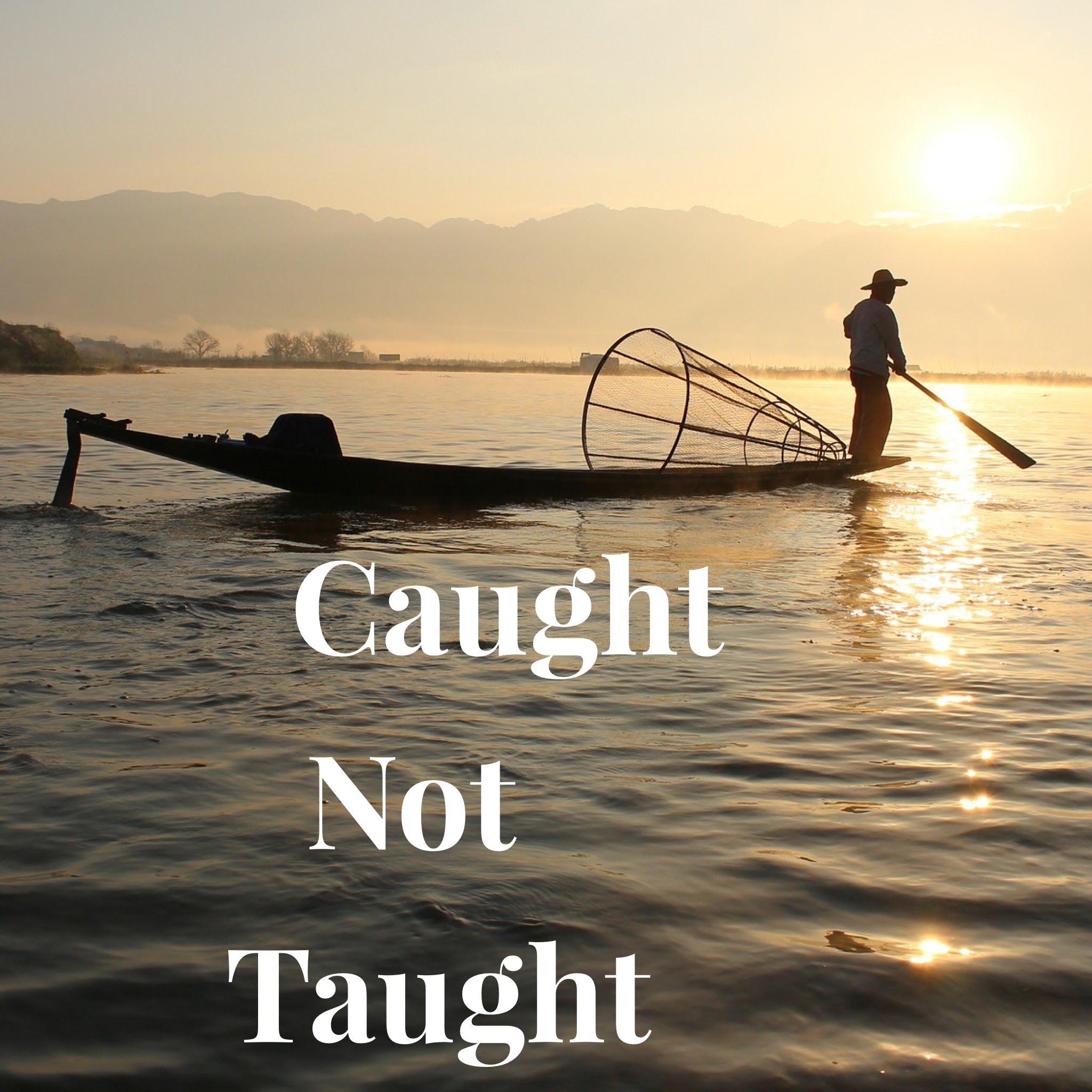
We might say that their enthusiasm for the faith was caught, not taught.

Today, Jesus talks about the Holy Spirit. He says clearly that the faith gets taught by the Spirit, who will teach us everything. But the Lord could just as easily have said that we are caught by the Spirit—captured by his action within us.

We see the Spirit at work in today’s first reading, from the Acts of the Apostles. False teachers are at work, but the Spirit guides the apostles in setting things right. Because what’s taught in the Church must, of course, be true.

In the second reading, St. John is carried away “in the spirit.” This could be read as meaning he was carried away “in spirit,” but I think it’s fair to say he was given this vision “in the Spirit”—by the Holy Spirit.

It’s not a teaching moment for John. He’s not being given a definition or even a literal description of heaven—he’s having an experience of it. He is caught up in this vision, caught up in the beauty of what God promises him and all believers.

This is how the Holy Spirit works best—by giving us an experience. This is how faith was caught when those young men met in the rectory—by an experience of Christian community in which God was at work.

Parents, teachers, and priests all worry about how to make the faith relevant to the younger generation and how to adapt it to a changing culture. But, in a certain sense, that’s not our job but the Holy Spirit’s.

In the first reading, we see a clash of cultures—between that of the emerging Church and existing Jewish beliefs.

The answer wasn’t obvious. The first Christians were Jews, faithful Jews, and it made some sense for Christianity to remain a Jewish movement. But when the apostles gathered and invoked the Holy Spirit—we don’t hear the whole story in this shortened passage—God showed his plan clearly, and they communicated it to the believers.

The Church has consistently asked the Spirit for help in meeting the demands of each generation, most recently at the Second Vatican Council. The Spirit will help each of us do the same in our homes, schools, and parishes—if we ask, if we pray for guidance.

The content of our Catholic faith is, of course, absolutely important. Without orthodox belief, we would be a ship without a sail. But the Spirit fills our sails with more than doctrine and teachings, however important they are.

A famous Anglican preacher wrote that “a Christian is someone caught by Christ’s spirit, the Holy Spirit, encountered in the life of some other man or woman, and in the worshipping community we call ‘the Church.’

 “And when we have been caught, then Jesus of Nazareth steps out of the pages ohistory, where he is not walled in, and becomes for us… the Christ whom we worship and in whose name we pray.” (D.W. Cleverley Ford, Preaching on Great Themes, p. 83)

How will this happen here at Christ the Redeemer?

More than one of our parishioners is blessed with what St. Paul (see Rm 12:6, 1 Cor 12:28, 29; 13:1-3, 8; 14:6, and Eph 4:11) calls the gift of prophecy, which doesn’t mean they stand on the church steps shouting out like John the Baptist.

We don’t talk much about prophecy, but St. Paul mentions it more than any of the other spiritual gifts. And although he doesn’t necessarily present them in order of importance, we usually find the gift of prophecy near the top of the list.

A while back, one of these parishioners gave the parish a simple prophetic message: “We need more Holy Spirit.”

“We need more Holy Spirit.” Those words are simple, but they have the power to change our lives.

Changed lives don’t happen automatically from good programs or good liturgies or even good teaching. The Spirit does the real work of evangelization, of conversion, and of growth.

As St. Paul tells the Christians in Corinth “I planted the seed, Apollos watered it, but God made it grow” (1 Cor 3:6).

Parents and teachers planted seeds in those young men who gathered in the rectory, their fellowship watered the seeds, but God made them bear a rich harvest.

Only with the Spirit’s help will faith be both taught and caught by those who are following in the footsteps of the MEAT men and of the young women who formed their female counterpart, a smaller group called Imprint.

(If you are wondering why I have only talked about the men it’s because I didn’t belong to the women’s group so there’s less I can say!)

Only if we ask will we receive the Spirit’s help. Pentecost is around the corner—two Sundays from now. It’s time to pray for more of the Spirit in our parish as we rebuild after the pandemic.

Let’s pray for more of the Spirit in our families and schools.

Most of all, let’s pray for more of the Spirit—a real outpouring—in our own hearts.

How do we do that? It’s sure not difficult: all we need to do is pray three words morning and evening for the next two weeks, and especially for the nine days before Pentecost.

“Come, Holy Spirit!” Words of power that ask God to grant us a faith that is not only taught but caught.

Sunday, May 8, 2022

All Called to be Shepherds Like Christ! (Easter 4.C)


Turn on the evening news, read the paper, or watch TV, and you’ll think this is a very violent world. Crime seems to be everywhere, almost the greatest risk of everyday life.

Well, let me tell you the true crime story for four generations of my family. My grandmother had her purse snatched in the carport of her apartment building more than forty years ago. End of story.

A purse-snatching. Not so scary. But not nice either, because it’s unexpected and sudden. In a single moment you lose many things of value, from money to keys, and you wonder where your credit cards will end up.

Today we hear Jesus talking about sheep snatching. Earlier in this chapter of John’s Gospel he talks about the thief who comes only to steal and kill and destroy; this verse is more about kidnapping than murder. Both, of course, are violent crimes that represent here the theft or murder of a soul.

Are we more afraid of  a thug in a parking lot than of the one who can steal our souls?

We should be. Sometimes the sheep-snatcher tries to carry off a lamb who belongs to us—a child, a sibling, a student, a friend.

We’ve almost all had the pain of seeing a loved one “fall away,” as we like to say. Maybe we should say “snatched away.”

But how does that square with what Jesus says in today’s Gospel: “What my Father has given me is greater than all else, and no one can snatch it out of the Father’s hand”? Is Jesus keeping his promise to protect his flock?

We know that God keeps his promises. If people are walking away from his flock, it can’t be that they’ve been snatched from the loving arms of the Good Shepherd. They must freely be leaving the sheepfold and wandering off. They can’t be taken violently, but they can leave freely.

There’s some consolation in this. Our fallen-away friends are not victims but free people. And we ourselves are not at the mercy of the Evil One and his schemes—the Good Shepherd is guarding us if we remain a part of his flock.

How does the Good Shepherd guard and protect us?

First, through the ministry of bishops. If Catholics couldn’t be sure of the truth, they would be easy pray for the snatcher of sheep. They wouldn’t recognize a wolf in sheep’s clothing, because his falsehoods would be camouflaged as new ideas, fresh ideologies, or just plain modern thinking.

Christ’s gracious plan protects those the Father has given him by allowing any member of the flock to recognize deception; whenever we hear doctrines or ideas in conflict with the authentic teaching office of the Church we know the sheep-snatcher is on the prowl.

Authentic apostolic teaching is the first protective fence around the flock of Christ. Brave bishops are good shepherds. This year, on the World Day of Prayer for Vocations, I think we should be praying that the Lord calls good men to be his bishops. Not only that, we should also pray that those whom he calls have the courage to say yes.

Second, through the ministry of priests. I can’t recall a parishioner who was faithful to Confession leaving the Church, although I am sure it’s happened. Faithful attendance at Mass also makes us strong, less vulnerable to being carried away from the sheepfold. It’s hard to go from worshipping the Lord with gladness, singing in his presence—as the Psalm says today—to rejecting Christ or his Church.

The increasing shortage of priests will soon mean decreased opportunities for Sunday Mass, especially outside of cities, and fewer opportunities for the celebration of the Sacrament of Reconciliation. When we pray for more vocations to the priesthood, we are praying for ourselves, that we will be shepherded by priests who are instruments of God’s grace and mercy.

Third, through the ministry of parents. Although we associate Good Shepherd Sunday with priests and religious, the vocation of the Christian mother and father has never been more crucial. Let’s face it: who tended Christ’s flock in my family with care and sacrifice? My mother and father, and especially my mother who as was normal in those days did the lion’s share of shepherding her lambs!

I once argued that the reason our prayer for vocations mentions only priests, deacons, and consecrated men and women was that there was no shortage of marriages, so we didn’t really need to pray for those. Of all the things I’ve got wrong over the years, this is near the top.

In the first place, there is a shortage of marriages! Outside the Church, cohabitation has taken its place. And even among good practicing young Catholics such factors as housing costs and social uncertainties have meant a plummeting number of marriages in almost every parish.

But more than that, we desperately need to understand marriage as a calling from God, a calling as indispensable as any ordained vocation. Every time I talk with Catholic teachers, in both secondary and elementary schools, I hear how the partnership between school and family falls apart when parents do not realize they are called to be shepherds—good shepherds, loving shepherds, countercultural shepherds.

Neither the best teacher nor the best pastor can protect the young without help at home.

Today is Mother’s Day. We honour our mothers. We give thanks for our mothers. But let’s also pray for the next generation of mothers, for they will need to be a sort of “tiger mother” to protect their children from the daily attacks they face in our confused society.

Finally, the Good Shepherd must have the help of every member of Christ’s Church. Every single one of us—priests, deacons, mothers, fathers, unmarried people—has a call to be a shepherd of the lambs and sheep around us.

As with so much else, our responsibility to shepherd one another comes from baptism and confirmation. This is particularly easy to see at the baptism of infants when the child is anointed with the oil of chrism. The celebrant says, “As Christ was anointed Priest, Prophet and King, so may you live always as a member of his body.”

What kind of a King was Christ? Like King David, he was a shepherd-king. So too with us. We are all called in baptism to lead others, young and old, with authority and courage, even into battle with the thief and kidnapper of their souls.

I watched a so-called “ordinary” parishioner take hold of the shepherd’s crook at our on Friday morning men’s group when he gave a presentation as part of our series on the Ten Commandments.

He had been assigned the two commandments modern society most rejects: the fifth, which deals with life issues such as abortion and assisted suicide, and the sixth, which covers human sexuality. Without hesitation or compromise, he shared solid Catholic teaching with the other men.

He led us directly from present confusion to the green pastures of solid truth.

Not everyone gets a chance to give a talk about the fifth and sixth commandments. I don’t recommend it at the dinner table with your teenagers.

What I do recommend is a lot easier. Lead your friends and family members to still waters. That’s what they’ll find next week at our “Water in the Desert” event on Saturday evening.

In a time of quiet and prayer, they can meet the Good Shepherd himself.


Sunday, May 1, 2022

Abundant Catch, Abundant Grace (Easter 3)


We all have different tastes, so I expect some of you like my homilies and some of you don’t. But one thing’s for sure—you can all be glad that I am not a saint! Because if one of the ancient Church fathers or the great doctors of the Church came to preach at Christ the Redeemer most of us would be left scratching our heads.

The homilies of these saints are full of meaning and insight, but they sure weren’t easy listening.

Still, the heavy hitters of early centuries had some fun with today’s Gospel—because, like us, they were struck by that curious number 153 in the story of the miraculous catch of fish.

We are used to symbolic numbers in the Bible. Twelve apostles, twelve tribes of Israel, ten commandments, and so on. But 153? That’s an odd number, and not just mathematically.

Many centuries ago, three of the greatest Christian thinkers tried to figure out the meaning of the 153 fish.

St. Augustine had the most fun with the number. He wrote that the catch of fish represents salvation, which requires keeping the ten commandments. But, on account of original sin, we cannot keep the commandments without the help of grace and the seven gifts of the Holy Spirit. Moreover, the number seven signifies holiness, since God blessed the seventh day and made it holy (Gen 2:3).

But 10 plus 7 equals 17, and if all the numbers from 1 to 17 are added together (1+2+3…+17), they equal 153. Hence, the 153 fish signify that all the God’s chosen people are to be saved by the gift of grace (7) and the following of the commandments (10).

How’s that for holy arithmetic?

My patron saint, Pope Gregory the Great says: There are ten Commandments representing the Old Testament plus seven gifts of the Holy Spirit, which also represents the New Testament, which added together make seventeen. This, times three times three, for our faith in the Trinity makes 153.

Much simpler is the theory of St. Jerome: In his time, they thought that there were only 153 species of fish in all the world. So, the disciples caught 153 fish, signifying the salvation of all the world.

Did all these great saints get the meaning of the miracle wrong?

Or did they all get it right? Not in mathematical terms, but spiritually. Because their convoluted answers teach us to pay attention to details.

The famous modern architect Mies van der Rohe said “God is in the details.” He was talking about buildings, of course, but his words apply to our spiritual journey also: God speaks in the details of our daily life and invites us to find him there.

The French spiritual writer Jean Pierre de Caussade wrote of “the sacrament of the present moment”—the place where we find God at work in all things and respond to him there.

De Caussade taught that there is not a single moment in life when we can say: this is an instant God has forgotten, an empty moment.

We just need to look to find God in everyday life.

Today’s Gospel reminds us that God has more than one way of speaking with us. Certainly, he meets us in church. But he also meets us at breakfast.

At the afternoon Mass on Easter Sunday, we heard the beautiful story of Jesus meeting the two disciples on the road to Emmaus. He spoke with them by explaining Scripture and showed himself in the breaking of bread. That direct communication is important.

But it’s not the only way. In today’s Gospel Jesus communicates with the disciples while they are at work. The amazing catch of fish is not exactly an everyday occurrence, but it’s something the apostles could easily understand.

And then he meets them not at a eucharistic table but at breakfast on the beach. The Lord makes his presence known to us in all kinds of ways if we will look for him in the events of our lives.

For all we know, Jesus didn’t have any number in mind when he granted the apostles a miraculous catch. You can ask Father Lucio or any fisherman — if you want to describe a whale of a catch, 153 is as good number as any!

Perhaps it was St. John who recognized that 153 represented abundance, that in counting the fish the apostles were counting their blessings, which were beyond number.

Maybe we can do something of the sort. Having three slices of pizza on my plate has nothing to do with the Trinity, that’s for sure. But it’s a reminder of an abundance of food at a time when many are hungry.

I made seven trips to Toronto to see my brother as he began recovering from his stroke. The seven sacraments were not part of my planning—yet I found God present and at work during every visit, often through the Eucharist and the anointing of the sick, but also in small details like the consistent welcome at the hotel where I stayed.

Perhaps this week you can keep an eye out for God’s presence in your life, for the ways he calls you to be aware of his love. Let’s cast the net and find him in daily details.

At the same time, we can’t forget that 153 fish reminds us of the rich and abundant life offered us by the Risen Lord. Graces overflow in this joyful Easter season and God calls us to land that catch in our daily lives.