Sunday, February 13, 2022

Living the Beatitudes Leads to Freedom (6.C)


This was my favorite Christmas present this year. I guess that's to be expected since I bought it myself!

It's the four Gospels, the first volume of the beautiful Bible being produced by Word on Fire, the ministry founded by Bishop Robert Barron.

The book features exquisite art, with essays about each illustration, introductions by fine Catholic authors and—no surprise—commentaries by Bishop Barron.

Bishop Barron has been called the Fulton Sheen of the 21st century. For those too young to remember Bishop Sheen, he was a pioneer in using radio and television—the social media of his day—to share the Gospel message.

There’s something else both men had in common: although they were able to communicate with all kinds of people, Catholics and non-Catholics, young and old,  they didn’t dumb down the message. Both were serious scholars with doctorates from prestigious Catholic universities in Europe.

You might say they were popular, but not popularizers.

And when I started to read the Beatitudes in my Word on Fire Bible, I also got more than I expected. I found  Bishop Barron's comments striking and new.

He starts. however, with the obvious, pointing out how strange these sayings sound. They contradict our experience.

I’ve only felt poor twice in my life, and I distinctly recall that there was nothing blessed about it. And being hated and reviled is surely worse still.

Bishop Barron tells a personal story that sets the stage for his thoughts about the Beatitudes. One Sunday afternoon there was a knock on the rectory door, and he opened it to find a man dressed in an expensive suit, projecting prosperity and confidence.

When the man said “Father, I’ve realized all my dreams,” Bishop Barron responded, “That’s wonderful.”

But it wasn’t. The man said “There’s only one problem. I’m perfectly miserable.”

His insatiable desire for money was an addiction that had robbed his life of meaning and joy. The “blessings” of success were a curse.

This leads Bishop Barron to interpret the Beatitudes in a very fresh way. He translates the Greek word used in the Gospel as “lucky” instead of the familiar “blessed” or even happy. And then he proposes this reading of what Jesus said: “How lucky are you if you are not addicted to material things.”

He carries on in the same way when he looks at “Blessed are you who weep now.” This, he says, we can understand as “How lucky you are if you are not addicted to good feelings.”

I always understood this beatitude as meaning only that we were blessed to weep because God would dry our tears in heaven. That’s true enough, of course, but the bishop draws out another meaning: feeling happy can be as much a false God as wealth if we can’t live without happy feelings, and want more and more of them.

Finally, he gets to the toughest of all these teachings: “Blessed are you when people hate you, and when they exclude you, revile you and defame you on account of the Son of Man.”

When I read that, I figured even Bishop Barron would have trouble finding any good luck in those situations.

But he didn’t. He translates the Lord’s words as “How lucky you are if you are not addicted to the approval of others.”

Bishop Barron says “Status, attention, and fame are among the most powerful… of the false gods who lure us.”  He backs it up with his own experience, describing how his need for approval—first from his father, then his teachers, then his professors—became an addictive pattern in his life.

Needing approval is a dangerous thing. It's certainly a bigger spiritual risk for me than wanting riches or good feelings. 

And being too concerned for the opinion of others is not only a risk for the spiritual life but for any life of integrity and courage. As Winston Churchill said, “Never trust a man who has no enemies.”

When Jesus says, “Woe to you when all speak well of you,” he is warning us that those who are spiritually free will inevitably find themselves in conflict with those who are still in chains.

Bishop Barron showed me a new way of looking at the Beatitudes, but his conclusion was very familiar. The blessing, the “good luck”, of being poor, sorrowful, or hated is the blessing of freedom, an inner freedom that nothing and no-one can take from us.

The path to such freedom is clear throughout the New Testament, where Jesus tells the rich young man to sell all he has and invites us all to pick up our cross and follow him. St. Paul tells us to take off our old self and leave it behind.

This path is the way of the saints. St. John of the Cross called it detachment, St. Teresa of Avila spoke of surrender, while St. Ignatius uses the term indifference. And the spiritual classic The Imitation of Christ has a chapter titled “How Surrender of Self Brings Freedom of Heart.”

And in our time, the Serenity Prayer used by 12-step groups calls it acceptance: “Lord, grant me the serenity to accept the things I cannot change…” By not living at the mercy of people and circumstances and events we find the true interior freedom to which Jesus calls us in the powerful words of today’s Gospel.

How blessed—how lucky we are—if we trust that God is at work in everything that happens to us, both the things we welcome and those we don’t.

Sunday, February 6, 2022

Sharing the Good News in Full Colour (5.C)

In my day there wasn’t a lot of training in preaching at the seminary. 

But we did get some, and I remember one lesson well. A visiting expert told us it was good to start a homily with something from the news.

It wouldn’t be hard to follow his advice today. This week saw the 70th anniversary of Queen Elizabeth on her throne and the Conservative leader Erin O'Toole toppled from his . The Olympics have begun, and the pandemic has, well, continued.

But I don't think we need current events to connect us with the scriptures we've heard this morning. They are timeless treasures of divine wisdom which should get our attention without a catchy introduction.

God’s word is inviting every person in church today, and everyone watching the livestream, to make a connection with our own lives. In other words, whether today’s homily succeeds depends on the hearers, not the preacher.

At first, we might not find it easy to make a personal connection—after all, the first reading is about a prophet who lived 2800 years ago, and the Gospel setting is a lake more than 10,000 kilometers from here.

But the fact is: Isaiah’s words are meant for our hearts, and the call of the apostles is a call for each of us.

It’s so easy to put the Bible in a box marked “ancient history,” when God wants us to place it front and centre of everyday life. Let’s look at how we can move the message of today’s first reading and Gospel from history to now, from ‘there’ to ‘here.’

We can start by stepping into Isaiah’s shoes. Forget about King Uzziah, whoever he was, and even about the six-winged seraphim. Look at what the prophet says: “Woe is me! I am a man of unclean lips, and I live among a people of unclean lips; yet my eyes have seen the King, the Lord of hosts.”

Shall we translate this? “Oh no! I am a sinner, like everyone else, yet I know who God is; I have seen his goodness and glory.”

That’s something any of us might say. We are sinners, ordinary sinners, so please don’t ask us to be prophets. If you want a parishioner to help with Bible studies, faith studies, prayer ministry or Alpha, I can give you some names. Just not mine!

But let’s keep reading. Isaiah’s fear and resistance melts away when the angel tells him his sin is forgiven. In an instant his lips are touched by divine fire and made ready for mission.

Here’s where stepping into Isaiah’s shoes becomes a challenge. We haven’t encountered an angel lately, so the prophet’s ‘yes’ to God seems impossible for us: “Here am I: send me!”

So, let’s leave Isaiah for a moment, and turn to the Gospel. Let’s stand beside Peter and the others washing their nets.

There’s no heavenly smoke and thunder there. Not even a single seraph. It’s just an ordinary workday for some fishermen, an unsuccessful one at that. But the same thing happens: God calls, and they answer.

Once again, the future disciple responds the way we might: “Keep your distance, Lord. I am not cut out for this.”

But God does the same thing for them he did for Isaiah: he takes away their fear. He gives them a mission that leaves no room for hesitation. Later, we see how Jesus equips those fishermen for great things.

There are so many problems in the Church today, so much sorrow for past sinfulness, so many who have turned away. And yet there’s one thing that lets me face those problems with hope and without discouragement: the rediscovery of the ordinary Catholic’s call to be a missionary.

My friend Father James Mallon lives in Halifax, a city that played a big role in the rescue of survivors from the sinking of the Titanic. In his book Divine Renovation, he recalls the well-known story of half-filled lifeboats, and of lifeboats that stayed at a distance while people drowned.

He's not just lamenting history: Father Mallon is warning us not to repeat it. We can’t be Christians who put our own safety—our own salvation—ahead of others’.

He reminds us that the Church exists for mission. “Like Jesus, we have been sent to ‘seek and save’ those who are perishing, and there are plenty of seats in the lifeboats.”

“Perhaps,” he writes, “if a few people swam over to us we would help them” but going to them “is totally outside our frame of reference.”

Slowly but surely, I see this changing in the Church, in our parish, in individual lives. We are moving from maintenance to mission; we are beginning to know that God didn’t call prophets and apostles only in the Bible; he calls them now.

And we—every one of us who has been baptized—are the ones he’s calling. We are the ones whose lips have been purified to preach. God wants to hear each of us say “Here I am—send me!”

As we restore parish life after the pandemic, forming joyful missionary disciples is job number one at Christ the Redeemer.

I haven’t mentioned today’s second reading yet, but it’s crucial. This passage from Paul’s first letter to the Corinthians is the rock on which everything else stands: the core message of salvation.

Do you remember what we said at Mass after the consecration before the Missal changed? “Christ has died, Christ is risen, Christ will come again.” That’s today’s second reading in a nutshell.

But more important, it’s Christian faith in a nutshell! Greek even has a word for it: kerygma. Kerygma literally means “preaching,” as distinct from teaching. Paul speaks here of the message he proclaimed—the good news that is the foundation of everything else.

Everyone knows that St. Paul taught many things about how to live the Christian life, but he only proclaimed one central message: “that Christ died for our sins in accordance with the Scriptures, and that he was buried, and that he was raised on the third day in accordance with the Scriptures.”

If we ‘get’ that, we get everything else.

And if we don’t want to share that, we don’t get it.

Father Mallon writes that many Catholics live in a black-and-white world without any conception of colour. I get that, because for years I watched only black-and-white TV, without feeling I was missing anything.

And of course, watching in black and white was fine—we still got the jokes in the comedies, and were scared by the dramas. But once you’ve watched in colour it’s hard to imagine anything else.

God invites us today, as individual Christians and as members of this parish, to experience the Good News of salvation in full colour.

When and if we do, it won’t be hard for us to answer, “Here am I—send me.”


Sunday, January 30, 2022

Catholics and Residential Schools: A Time to Listen (4.C)

We were looking forward to the visit of Deacon Rennie Nahanee to the parish today. Deacon Rennie, a permanent deacon of our Archdiocese, is a member of the Squamish Nation and was to preach at Mass and bless the land acknowledgment plaque the parish has recently installed at the entrance to the church. Unfortunately, he fell ill last week and is now recovering at home.

The coordinator of Christ the Redeemer's reconciliation effort had the inspired idea to invite another permanent deacon to preach today so that we continue our focus on the residential schools and reconciliation . I had circulated to our committee an earlier homily given by Deacon Bruce Fraser and she thought he could readily revise it for our benefit.

Which is how Deacon Bruce came to preach at the parish this morning while we await Deacon Rennie's visit and the blessing of the plaque. His inspiring homily follows...

In today’s Gospel, Jesus is having a tough time in his hometown of Nazareth.

His family and friends can’t get over their preconceived notions of who He is.

As a result, they’re blocking His announcement of the Kingdom of God.

They can only see “Jesus, the guy we watched grow up”. They cannot see a prophet. In effect, they think that He is pretending to be something that He isn’t.

Jesus tells them as much to their faces, and they are so offended that they try to throw him off a cliff.

Jesus does not perform any public miracles at Nazareth. He recognizes that anything extraordinary He would do there would not help bring the Kingdom of God any closer to reality there.

If He were to perform a great sign, his friends and family would see it only as a show, a spectacle, not a symbol pointing to a deeper reality.

And so, unable to draw them closer to the Kingdom, Jesus chooses to do nothing.

However, Mark tells us in his version of this story that Jesus does, “lay his hands on a few sick people and cure them.” Where Jesus does find people who are receptive to the Kingdom, He does perform miracles for them, but these are quiet acts done for individual people, not public acts to inspire large crowds.

Jesus keeps his ministry in Nazareth low key because He sees that public spectacles and public speeches are not going to help.

                                                         ***

This is a tough time to be a Catholic Christian in Canada.

Last year, the discovery of unmarked graves at the Kamloops Indian Residential School and the later discovery of unmarked graves near the former Marieval Indian Residential School in Saskatchewan left a lot of people angry at the Catholic Church. And this week we heard about 93 possible burial sites around the residential school near Williams Lake.

There are some people for whom these discoveries have opened old wounds and caused old pain to resurface.

There are others who were already angry at the Catholic Church for other reasons, and these discoveries have given them new energy and new ammunition.

There are also many Catholics who are angry that their Church could have been involved in something so wrong as the Residential School system.

So how should we cope with this situation, as Canadians and as Catholics?

How do we cope personally? Looking inward, how do we stop the onslaught of distressing news from crushing our spirits?

Looking outward, how do we cope with a newly hostile world?

 For my part, I have started to educate myself.

For breaking news, I stay away from the mainstream media.

I turn instead to interviews and opinions by the people closest to these events, 

to see what they have to say.

The words of the people directly affected by these events are both moving and inspiring. They speak of anger, but also of reconciliation and moving forward together. They speak of pain and suffering, but also of listening, learning, and solidarity.

For example, when the Catholic Church in Penticton burned down last year, I ignored the CBC and Global News, and went straight to the Penticton Western News, which printed a brief interview with Greg Gabriel, chief of the Penticton Indian Band. Chief Gabriel said that there was a lot of anger and a lot of pain in the community over the Residential Schools, but he condemned the burning of the church. He said, “Many in our community were members and involved in services.” He added that those people are hurting because the church was where they went to grieve and pray over what had been found in Kamloops. In reading his words, I realized that what was meant to hurt the Catholic Church in general had instead hurt the very people who were already suffering. It was not just a church that some angry people burned down, but their church.

The press releases sent out by the First Nations who commissioned the ground radar surveys speak of their pain, but also of their desire to be given time: time to process what has happened, time to find answers to their questions, time to grieve.

The Truth and Reconciliation Commission, which ended in 2015, has a website containing all of its documents. Some of them are enormous, and I’m a slow reader. Nonetheless, I am working my way through them as I am able. I’m doing this to educate myself, but also because this is one of the few things that Indigenous leaders have asked non-Indigenous people to do in solidarity with them. They have called for all Canadians to educate themselves by reading the Truth and Reconciliation Commission reports. That is something that we can all do.

So far, what I have read speaks of the trauma and suffering experienced by Indigenous students at the schools, but it also calls for solidarity and reconciliation so that we can move forward together—Indigenous and non-Indigenous people—in gradual, small steps, as those who carry the trauma of the Residential School system in their hearts feel ready to do so.

 So, that’s educating ourselves, but how do we as Catholics deal with a newly hostile world?

This is where we can take an example from today’s Gospel. Jesus recognized that preaching the Good News of the Kingdom of God in Nazareth wasn’t going to go anywhere. He also recognized that defending His reputation by performing some flashy miracles wasn’t going to help. So, He didn’t do either.

This wasn’t an act of condemnation. It was, rather, a prudential assessment of the situation. “Wrong time, wrong place. Not now. Not yet. Maybe some other time.”

Right now, non-Christian Canadians are probably not going to be receptive to hearing about our Faith. They’re not going to be able to get past who they think we are in order to pay attention to what we are saying.

Nor is this the time to publicly correct any errors we’ve heard in the media. 

If someone is truly interested in the Catholic point of view, we should be happy to share it. But if someone is angry at the Church, then correcting mistaken ideas is just going to sound defensive. It’s going to sound like all we care about is protecting the Church’s reputation and that we don’t care about what the Residential School system did to the First Nations people.

Now is not the time to talk. Now is the time to listen.

Especially and always we must listen to the people directly affected by the Residential Schools: the survivors, the children of survivors, the groups of people coping with generational trauma as a result of the Residential School system.

However, it’s also time to listen to people who are angry at the Church for other reasons.

If I have educated myself about what happened at the Schools, using the stories and materials produced by the very people who lived that experience, then I can put what people are saying to me in some sort of context. I can acknowledge their pain and their anger without letting it crush me. I can focus on what I can do to help them, if they want my help, rather than becoming defensive and reacting out of my own pain and frustration.

 “Preach the Gospel at all times; when necessary, use words,” is the most famous thing that St. Francis of Assisi never said.

What this expression means is that there are times when telling people the Good News about God and His Kingdom… when telling people about the beauty and the majesty of our Catholic Faith… just comes across as noise. There are times when the people you meet, like the people of Nazareth, can’t see past their preconceived notions about who you are and what you are about in order to hear the message you have for them.

In cases like that, the best thing to do is to act like a Christian rather than making lofty speeches. In today’s climate, that means listening rather than talking.

In the second reading, St. Paul reminds us that “Love is patient; love is kind; love is not envious or boastful or arrogant or rude. It does not insist on its own way; it is not irritable or resentful.”

St. Paul is telling us that if we speak truth, but we do it defensively or rudely, then it doesn’t matter if we have our facts straight: we still lose. Love must come first. “What is the loving thing for me to do here?” is the first and most important question, and often that loving thing is just listening.

 In Mark’s version of today’s Gospel, though, Jesus does evangelize a little bit.

You may meet a few people who want to tell you about their pain and their anger, but also want to hear about your experience as a Catholic, people who are genuinely interested in your point of view.

If you meet someone like this, the first thing to do is apologize.

As Canadians, we recognize that the Residential School system was a bad idea. 

As Catholics, we’re sorry that the Church ever got involved in that system. 

If we could turn back the clock, knowing what we know now, we as a Church would not have cooperated in it. We’re also sorry that within the Church’s involvement in what we now know was a terrible system, some individual Catholics went beyond even that and abused the children in those schools, or turned a blind eye to their abuse at the hands of others, making their horrible experience even worse. We need to make it clear that the whole thing was a disaster and that we would never want to see it repeated.

Then, perhaps, having apologized, we can talk about how this has affected us as Catholics.

If that seems unfair, apologizing for something that you had no personal hand in doing, listening while other people rail at you for being Catholic, then remember that our discomfort is nothing compared to what many Indigenous children suffered at the Residential Schools.

In recognition of that level of pain and ongoing suffering, the Christian thing to do… the prophetic thing to do… the loving thing to do… is to listen.
Sunday, January 23, 2022

Sunday of the Word of God 2022


Pope Francis missed out on last year’s Sunday of the Word of God because his sciatica was acting up. It must have been doubly painful for the Pope, since he had only established this special Sunday in 2019.

The Holy Father is making up for it this year: he’s celebrating Word of God Sunday by conferring the ministry of lector on lay men and women for the first time. Until now, only men were formally instituted as lectors, almost always on their way to ordination.

By admitting women to the ministry of lector or reader, the Pope is reminding us that all the baptized, not only the ordained, have a special relationship with Sacred Scripture. This formal recognition is, of course, just icing on the cake, since women have been reading at Mass for many years now.

And there’s even more happening at today’s historic celebration at St. Peter’s Basilica. The Pope will also confer the brand-new ministry of Catechist, which he established last year on several laywomen and men.

It will take a while before developments like these make their way from Rome to Vancouver. But the values behind them, the service and calling officially recognized by these lay ministries, is here already and here to stay.

So today’s a great day to ask: what am I called to do on this Sunday of the Word of God—not by the call of the Pope or Archbishop but by our baptism.

Because all the baptized are called and commissioned to proclaim the Word of God in one way or another.

At first glance today’s readings aren’t obviously about the Scriptures themselves—for instance, I would have preferred to hear what the Letter to the Hebrews says about the Word of God being living and active, a two-edged sword.

Yet the late Cardinal Vanhoye, my favourite Biblical scholar, says that this Sunday’s readings do an excellent job of showing us the importance of the Word of God. [See Albert Vanhoye, SJ, Le Letture Bibliche delle Domeniche: Anno C, p 178]

In the first reading, Ezra and his fellow priests moved the people to tears by reading from the Law, which is to say from the first five books of the Old Testament, traditionally written by Moses. The reaction of the crowd proves the point made by Hebrews. God’s word was living and active in the hearts of all who heard, piercing them right through.

In today’s Gospel, the circumstances in which the Scripture is read are ordinary—just a Sabbath service, a congregation much like ours this morning.

But the reader is anything but ordinary: as Jesus reads the prophetic words of Isaiah, they are fulfilled for all time. There’s a good reason the people in the synagogue could not take their eyes off him.

The reaction of the emotional crowd at the Water Gate and the attentiveness of the congregation in the synagogue at Nazareth are models of how to listen to the Scripture even for us today, because the liturgical reading of the Word requires both proclamation and reception—a partnership, as it were, between reader and hearer.

Personal contact with the Word of God through the Bible, both the Old and New Testaments, can be life-changing. Cardinal Vanhoye tells us how important it is for us to be aware of this Word, because it can guide, comfort, and help us in every circumstance of life.

There are two ways this can happen. One, of course, is by turning to the Bible for guidance and consolation in times of trial. But this is hard to do if we are not familiar with the general outline of God’s Word—which is why the second way is listening attentively at Mass and privately studying the Bible in good times, so that we know where to turn in times of trouble.

On this Word of God Sunday let’s ask the Lord for the grace to be truly open to hearing his Word—for the grace of active listening to both Testaments, Old and New, in church and at home.

And during this Week of Prayer for Christian Unity, let’s give thanks that we share the Scriptures with our fellow Christians, some of whom provide us with a fine example we would do well to imitate.

Saturday, January 1, 2022

Epiphany: Offering What We Have


We live in anxious times.  Just when we thought the pandemic was cooling down, it starts to heat up. And the coronavirus isn’t the only reason for worry: we saw more natural disasters in BC last year than in a typical decade.

On top of all that, we have the opioid crisis, growing homelessness, refugees drowning, and growing political tensions at home and abroad.

It makes you feel a bit helpless, doesn’t it? What can we do in the face of so much calamity?

Today’s feast of the Epiphany contains at least one answer: do what you can. Offer what you have.

The wise men aren’t well-prepared for a newborn. Everyone’s seen the old internet joke that says if there’d been three wise women, they’d have made a casserole and brought practical gifts.

But what did the wise men do? They gave what they had.

Their example offers us a way to respond to any and every crisis: we do what we can, with what we have.

There’s even a name for this: Christian stewardship.

Christian stewardship “offers us a way to re-focus our energy and provides an opportunity to face today’s challenges.” (See the fine reflection of the International Catholic Stewardship Council here.)

Sometimes we make the mistake of thinking that stewardship is all about money; that’s a particular danger on the Epiphany when the word treasure appears in the Gospel.

Yet “a conversion of the heart is needed before a conversion of the wallet or purse can happen.”

We’ll never be Christian stewards if we don’t experience the joy of the wise men, whose hearts opened wide when they reached their destination, who knelt in wonder when they saw the child Jesus and Mary.

It was the Holy Spirit who invited them to open their treasure chests in an act of homage that will be recalled until the end of time.

And it is the Holy Spirit who will help us discover what we can do to respond to the needs we see all around us.

We offer our gifts of time, talent, and treasure not simply to those in need but to God himself. Prayerfully, with the Spirit’s guidance, we ask him “what should I do?”

Over the years, we have talked about stewardship many times in the parish. But this feast of the Lord’s Epiphany can inspire us to think about what’s most precious to us, and how we are called to share it.

Surely the most precious of all our gifts is our faith. We are in church today because we believe in the mystery of Christ’s birth, the Word made flesh.

We believe that the ancient prophecies have been fulfilled, and that the world no longer needs to fear the darkness; the light has come.

Isn’t that the first treasure of which we are all stewards? Aren’t we called to take our faith out of its box and share it with others, especially those who most need the hope it offers in these difficult times?

In less than three weeks, Alpha will begin online.

If your heart needs to hear a Gospel message of hope, please sign up. Perhaps more importantly, ask the Holy Spirit to point you to the friends, neighbours, and family members for whom Alpha could bring light and peace.

Charity, as they say, begins at home. But today’s feast also reminds us of the global picture. All nations are called to Christ’s light and all people matter to us. We see this clearly in the psalm, where the tribute offered to God is given to the needy, to the poor, to the abandoned, and to the weak.

And so it is that the parish pastoral council and the parish finance council has decided that Christ the Redeemer will again sponsor a large refugee family, this time from Eritrea in Africa.

We’ll share details in the coming weeks, but for now I can only rejoice that our parish community can make this commitment thanks to its deep spirit of stewardship and charity.

There are many needs besides Alpha at home and refugees abroad. So this Epiphany let’s ask ourselves “what else is in my treasure chest? What more can I do with the time, talent, and treasure that God has given me?”

In a tough time, we do what we can, with what we have.

Mary, Model of Prayer (January 1)


Most of the reflections in my brief homily today are not my own: they are my rough translation of the commentary on the readings offered in Le Letture Bibliche delle Domeniche: Anno C by Albert Vanhoye, SJ. Cardinal Vanhoye, who died last July, was a brilliant and pastoral scripture scholar, and wrote in a wonderfully clear Italian, perhaps because it was not his first language.

But I have one personal thought to share. Those of you who have come to Mass today are doing a very Catholic thing.

All Christians have a solemn invitation to Sunday worship; it comes from the Ten Commandments and ancient tradition. It’s a matter of divine law.

But this holy day—other than Christmas, the last remnant of the seven or so holy days of obligation we observed when I was in elementary school—is a matter of Church law. You’re doing a truly Catholic thing, obeying the authority of the Church by attending Mass.

Of course, I am not suggesting that all or even most of you are here simply because you’re supposed to be! We begin a new year today and we begin it under the protection of Mary. That too is wonderfully Catholic.

Eight days after the birth of Jesus we recall his mother: and in a special way we ask her to obtain peace for us, since today is also the world day of prayer for peace.

The first reading is chosen precisely for the first day of the year: it’s a priestly blessing taken from the Book of Numbers.  The formula of the blessing is extraordinarily rich. It invokes the sacred name of the Lord three times and prays that we will live under the watchful and gracious gaze of our loving God.

But the last word of the blessing is peace. And here we ask not only for the absence of war but rather prosperity, welfare in all things, a truly happy new year free from conflict and distress.

The Gospel leads us back to Bethlehem, to that timeless picture of Mary contemplating her newborn son. At the beginning of this new year, we ask for the grace to know her a little better, to understand her place in our lives and in our Church.

We get a glimpse of Mary’s profound interior life as she ponders Christ’s birth in her heart. Deepening our own inner life through the reading of scripture, times of reflection, and especially by meditating with the Rosary would be a terrific new year’s resolution for any of us.

The second reading tells us that we will have lots of help if we decide to imitate Mary by treasuring the mysteries of our faith through regular prayer. The Holy Spirit who first came to Mary now comes to us; yes, she is the Mother of God, but we are sons and daughters of God, and the Spirit dwells in our hearts.

What a blessing for us to begin 2022 together with Mary, together with the Church, together with one another.

Saturday, December 25, 2021

Children's Mass (Christmas 2021)


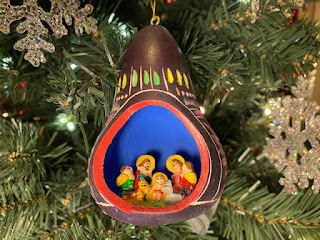
We have a wonderful family in our parish who moved to Canada from Peru. They just gave me a lovely gift – a brightly painted Christmas ornament from South America.

 It’s made from a gourd, a hard-skinned fruit that’s been hollowed out and dried. Gourd carving has been associated with Peru and other countries in South America for hundreds of years.

You can see it’s quite pretty; there’s a cheerful little bird chirping at the bottom.

It would look nice enough on a Christmas tree, if I hung it as you see it now. But if you turn it around, you see that the ornament has a heart. Far from being hollow, like most of the decorations on my tree, it has tiny figures of Jesus, Mary, Joseph, shepherds, and animals. 


We have to decide every Christmas whether to look at one side or the other – to focus on the colourful decorations or to take a careful look at what Christmas is all about.

 Sometimes it’s easier just to see Christmas from the outside. Certainly, at least with my eyesight, it takes a bit more effort to look into the heart of this celebration.

But there’s so much to learn when we take the time to gaze at the miracle we are here to celebrate tonight.

 You can be sure that the shepherds couldn’t take their eyes off the angel. And when the angel left, they were changed, they were eager, and the result was that they received the priceless gift of seeing Mary and Joseph and a child lying in a manger.

We have a beautiful crib in our parish, and I hope that many of you will visit to say a prayer. But no matter how long you look at the statues, you will not find Mary and Joseph and their child. Because they are not statues!

But if you look into your heart, you will find Jesus, Mary, and Joseph. You will be able to speak with them. You can imagine how the shepherds felt, and you can feel that way too.

All you need to do is make up your mind and change the angle from which you view Christmas. Opposite the shiny and colourful side there is the real meaning of Christmas, which is the appearance of God our Saviour with goodness, loving kindness, and mercy.

We adults can lose our sense of wonder. We’ve had many Christmases and maybe we have begun to take the annual celebration for granted.

That’s why our parish wants to offer adults, young and old, a chance to look at Christmas with fresh eyes – an opportunity to get inside Christian faith. Alpha is an eleven-week video series that helps us understand why God became man and what that means for us. 

Please join us January 20, on line!